Identity Reporting for CISOs and CFOs: Avatier Persona Briefings
Identity reporting for executives means one evidence set, answered three ways. What the CISO, CFO and security team each need, and how Avatier Ledger's Persona Briefings deliver it.

Identity reporting for executives means one evidence set, answered three ways. What the CISO, CFO and security team each need, and how Avatier Ledger's Persona Briefings deliver it.
- Executive identity reporting works when one evidence set answers three questions: what to fix first, what identity costs, and where you are exposed.
- Avatier Ledger turns every outcome into evidence and every report into a question, and its Persona Briefings tailor the answer to the CISO, the CFO and the security team.
- The CISO briefing blends applicable compliance frameworks with identity and password statistics and highlights remediation in 0–30, 30–90 and 90-plus-day windows, formatted for the organization's own IT auditors.
- The CFO briefing focuses solely on cost and breach prevention; the security team's covers exposure, dormant and orphaned access, privileged activity and the help-desk vishing surface.
- Under Pay Per Identity Action™, customers pay only for completed, verified, policy-compliant outcomes, and every completed outcome already carries its receipt.
Identity reporting for executives is the practice of answering one body of identity evidence three ways: as control evidence and remediation priorities for the CISO, as cost and breach prevention for the CFO, and as live exposure for the security team. The data underneath is the same. The question each reader brings is not.
That gap is where identity reporting can stall. When reporting starts from an export, someone reshapes it for the board deck, someone else rebuilds it for finance, and by the time each version lands, the numbers have moved. Avatier Ledger, one of two Model Context Protocol (MCP) connectors Avatier announced on September 24, 2026, takes a different approach. It "turns every outcome into evidence and every report into a question," and through Persona Briefings, it tailors the answer to the person asking.
Why one identity report can't serve three readers
This section is general guidance, not a description of any product.
A report built for one reader leaves the other two doing translation work. A list of open access-review items is useful to the security team and says little to the CFO. A spend summary helps finance and says nothing about which accounts are exposed. A compliance mapping satisfies an auditor but doesn't tell the CISO what to fix first.
The fix is not three separate data pulls. Three pulls mean three versions of the truth, and executives who compare notes will find the seams. The stronger pattern starts with one evidence set and changes only the framing: the same completed actions, the same accounts and the same dates, answered in the terms each reader uses to decide.
What each executive needs from identity reporting
The table below is general guidance on what each reader needs, drawn from the decisions each one makes. It is not a list of Avatier features; those follow in the next section.
| Reader | The decision they make | What a useful identity report gives them |
|---|---|---|
| CISO | What to fix first, and whether control can be proven | Control status mapped to the frameworks in scope, open findings ranked by urgency, evidence in the auditor's format |
| CFO | What identity costs and what it helps prevent | Spend tied to work actually done, cost trends, the financial case for prevention |
| Security team | Where an attacker could get in today | Exposed accounts, dormant and orphaned access, privileged activity, social-engineering risk at the help desk |
For a CISO, IAM metrics earn a place in the report when they connect to a decision: how many findings are open and for how long, which controls have current evidence, and whether the trend is improving. A raw count with no time dimension and no owner is hard to act on.
For a CFO, the useful frame is cost per completed outcome rather than cost per license, because it ties spend to work that happened. For the buying side of that argument, see Outcome-Based Software Pricing: A CFO's Guide.
How Avatier Ledger's Persona Briefings answer each reader
In CEO Nelson Cicchitto's words, customers "don't export a report; they ask a question and receive the answer in the form their auditor, their CFO, or their security team actually needs." Avatier's September 24 announcement describes three Persona Briefings, each built from the same evidence.
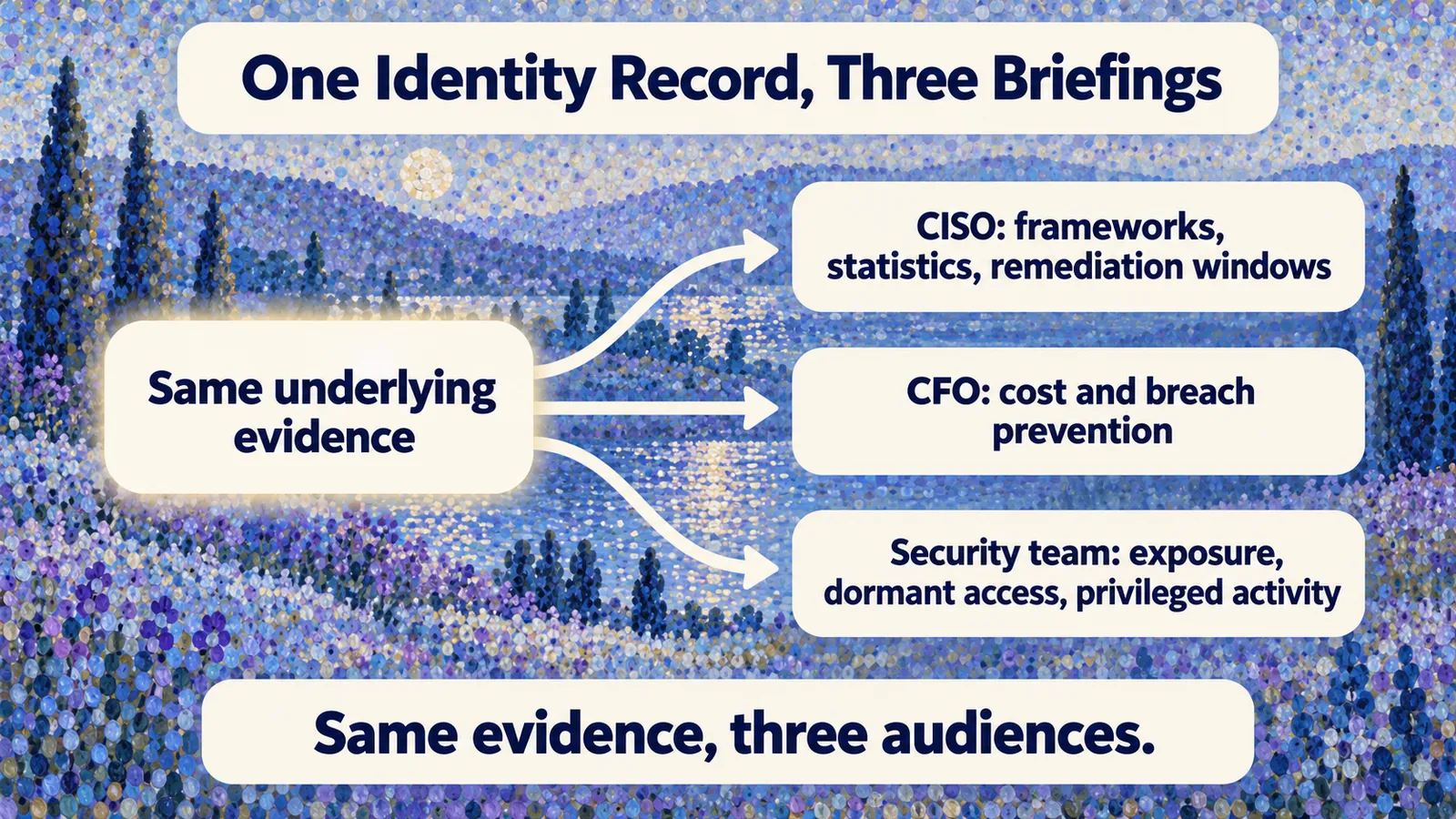 One evidence set, three readers: Avatier Ledger's Persona Briefings change the framing, not the underlying data.
The CISO briefing. According to the announcement, "A CISO receives every applicable compliance framework blended with the organization's identity and password statistics, remediation highlighted in 0–30, 30–90, and 90-plus-day windows, formatted to the evidence templates and language of the organization's own IT auditors."
The CFO briefing. "A CFO receives the same underlying data focused solely on cost and breach prevention: identity spend reconciled to completed actions, and year-over-year cost projections modeled from the organization's own churn and identity data combined with regional labor and technology-stack benchmarks."
The security team briefing. "The security team receives a third briefing built around exposure, dormant and orphaned access, privileged activity, and the vishing surface at the help desk."
The announcement sums it up as "Same evidence, three audiences, no analyst weeks in between." Avatier CISO Sam Wertheim describes Ledger as recording "who asked, what ran, under whose authority, and what policy allowed it" for every action, "and then tells each stakeholder what it means in their own terms." For how that record is built, see AI Agent Audit Trail: How Avatier Ledger Records Identity Actions.
The announcement also describes a live demonstration: a termination executed by asking, with the audit evidence printing at the end, followed by the CISO and CFO briefings generated from it.
The remediation windows in the CISO briefing
The CISO briefing highlights remediation in three windows: 0–30, 30–90 and 90-plus days, formatted to the templates and language of your own IT auditors.
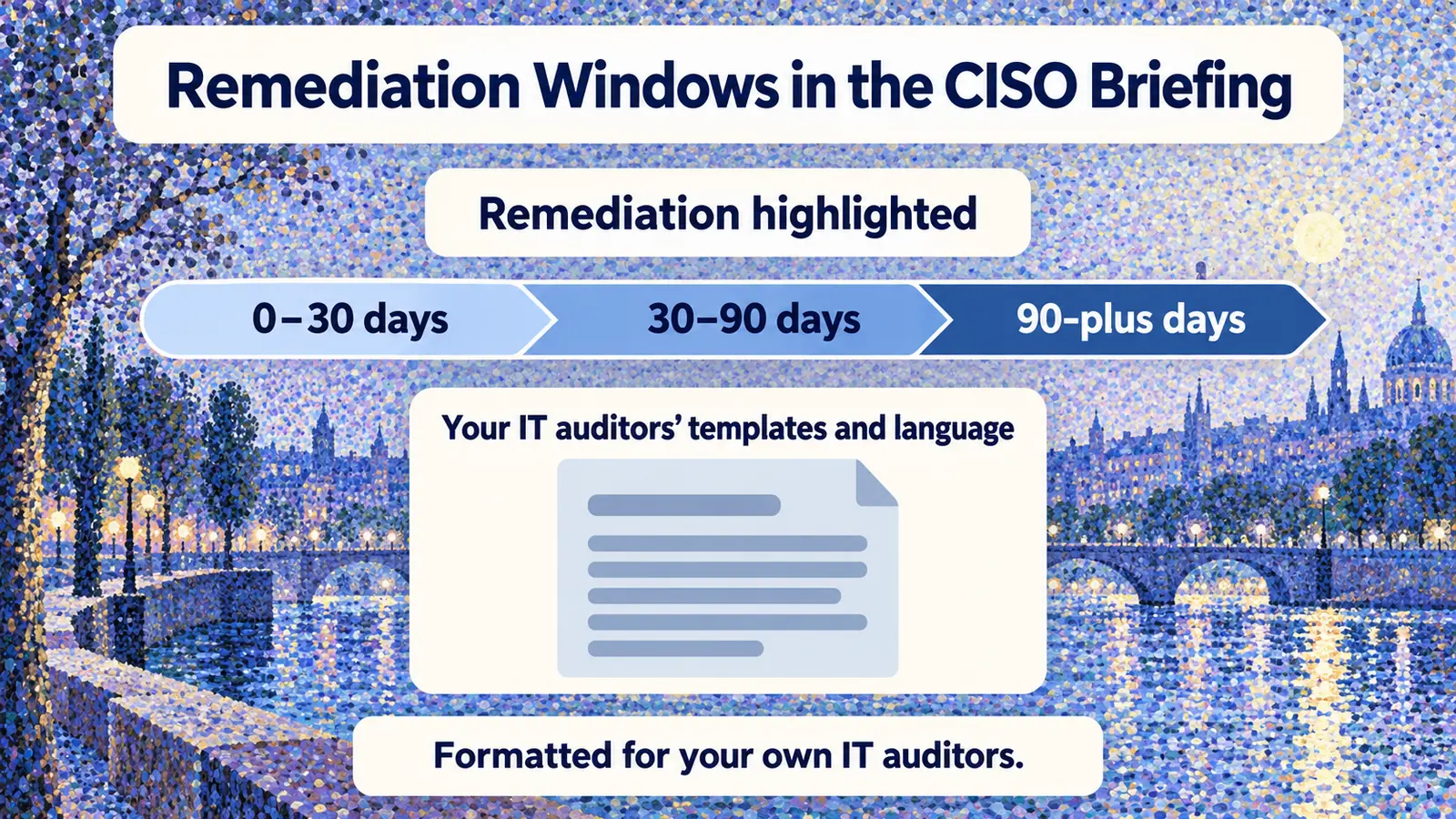 Three remediation windows in the CISO briefing, formatted to your own IT auditors' templates and language.
Time is the reason windows matter. Avatier's Identity Attack Ledger, which reads breach notifications filed with the California Attorney General, finds a median of 157 days between the start of a breach and the filing of its notification, across 2,030 California filings from January 2023 through August 14, 2026. That span includes the undetected period, the investigation, legal review and the notification itself, so it is not time spent undetected alone.
As general guidance, three habits make windowed remediation useful to an executive:
- Agree the placement rules with your auditors before the first briefing, so findings aren't argued one by one.
- Report movement between windows, not only totals. A finding that slides from 30–90 into 90-plus is a story on its own.
- Give every 90-plus-day item a named owner and a decision: fix it, accept it with sign-off, or remove the access.
For the wider automation picture behind regulatory reporting, see AI-Driven Regulatory Reporting: The 2026 Automation Playbook.
What Avatier ships toward this pattern
Avatier Ledger turns every outcome into evidence and every report into a question, with Persona Briefings for the CISO, the CFO and the security team.
Avatier Actions, the companion connector, exposes more than 50 identity outcomes as MCP tools across eight modules, including Access Governance and Reports. An employee or manager asks in Teams, Outlook, Claude or Copilot, and the outcome runs through the customer's existing policies, approvals and roles, because the assistant is the interface, never the authority. Setup is one administrator connection, with permissions inherited from Microsoft Entra ID, Active Directory, Okta and Ping.
Pricing is Pay Per Identity Action™: customers pay only for completed, verified, policy-compliant outcomes. In the announcement's words, "every charge is an outcome that completed, and every completed outcome already carries its receipt." Getting started is free, deployment services are included, and a 45-day money-back guarantee applies. For the model in depth, see What Is Pay Per Identity Action™.
Both connectors are available through Avatier Identity Anywhere 2027™. For the platform and the live demonstration, see the Avatier Identity Anywhere 2027 site. For credential lifecycle, see Credential Governance. For help-desk caller verification, see Assisted Reset. For the company, see avatier.com. For compliance, see the Avatier Trust Center: SOC 2 Type II audited with no exceptions noted, and ISO/IEC 27001:2022 certified.
ABOUT THE AUTHOR

More from IAM & Identity Governance

Shadow AI Agents and the Sanctioned Path Avatier Provides
A shadow AI agent acts with borrowed credentials and no owner. How shadow agents get access, how to find them, when to govern or retire one, and the sanctioned path Avatier provides.

Automating Access Reviews with AI: Avatier Actions and Avatier Ledger
AI can prepare, route, and evidence access reviews, but a named reviewer still decides. Where AI belongs in certification, the evidence auditors test, and what Avatier ships.

Joiner-Mover-Leaver Automation: Governed Changes with Avatier
Joiner-mover-leaver automation runs every lifecycle change as a governed identity action. Why movers are where access piles up, and how Avatier runs changes through policy.