Progressive Profiling in CIAM: The Consent-First Playbook for 2026
Progressive profiling builds a customer identity profile in small, consented steps across sessions instead of demanding it all at registration — here's how the consent mechanics actually work.
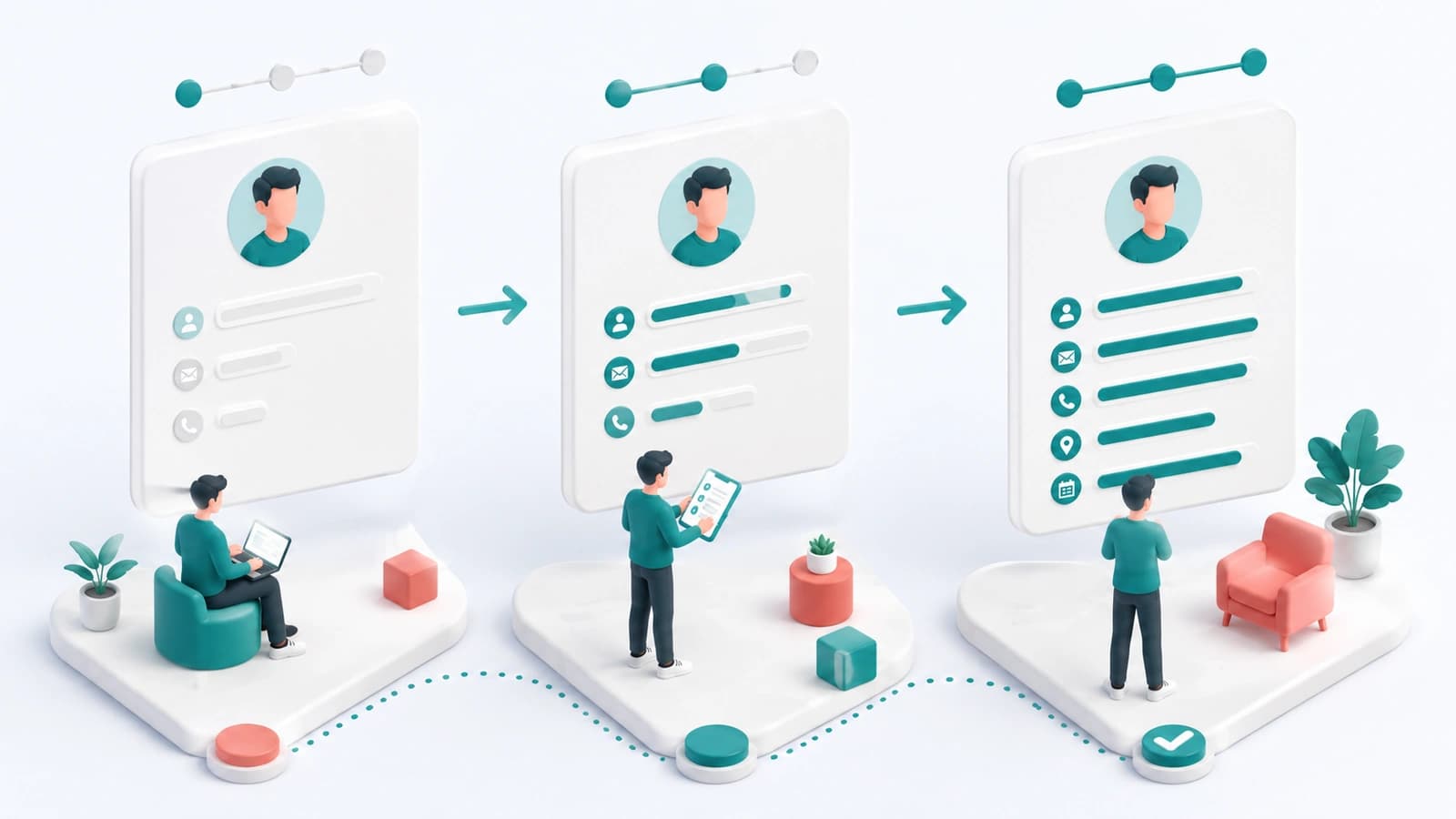
Progressive profiling builds a customer identity profile in small, consented steps across sessions instead of demanding it all at registration — here's how the consent mechanics actually work.
- Progressive profiling is a data-collection pattern, not a registration redesign: it collects customer attributes incrementally across multiple sessions, asking for a little at each interaction instead of everything up front, and each ask should carry its own consent scope rather than borrowing blanket consent from account creation.
- The consent mechanics are the actual engineering problem. Each staged data request needs a purpose tied to it, a record of what was asked and when, and a revocation path — a profile built from five separate consented asks is five separate consent records, not one record with five fields.
- GDPR and CCPA both reward this pattern structurally: purpose limitation and data minimization are easier to satisfy when you only collect an attribute at the moment you have a specific, statable reason for it, instead of collecting everything speculatively at signup and hoping the purpose shows up later.
- The UX case is real but has a ceiling — shorter initial forms measurably reduce abandonment, but progressive profiling only outperforms a single well-designed form when the staged asks are tied to moments the customer perceives as earning them something back. Poorly timed staged asks just spread the friction out instead of removing it.
- None of this substitutes for governance. A consent architecture that's broken at the source produces broken consent records no matter how well-timed the staged asks are, and progressive profiling has no answer for stale, orphaned, or unrevoked profile data that governance — not collection UX — is responsible for cleaning up.
Progressive profiling collects a customer's identity attributes incrementally across multiple sessions — a field or two at a time, tied to a specific moment and a specific consented purpose — instead of demanding a complete profile in one registration form. The profile ends up just as complete, sometimes more so, but it's built through a series of small, contextual, individually consented asks rather than a single transaction that front-loads all the friction before the customer has seen any value. The pattern is not primarily a UX trick, even though the conversion benefits are real; it's a consent architecture problem first and a form-design problem second.
This is the 2026 update of our earlier piece on progressive profiling in CIAM. The original made the UX case for staged collection. This version narrows the scope deliberately: it stays inside the consent mechanics, the GDPR/CCPA-safe patterns for staging what you collect, and the honest tradeoffs — rather than treating progressive profiling as a growth-marketing tactic with privacy as an afterthought. Our CIAM vs. workforce identity piece already covers how customer identity differs from workforce identity broadly; this piece assumes that distinction and goes one layer deeper into a single mechanic inside CIAM.
What progressive profiling is — and what it isn't
Progressive profiling is specifically about the timing and staging of data collection, not about identity verification, authentication strength, or account security. It answers one question: when do you ask a customer for a given piece of information, and how do you justify asking for it at that moment rather than another. It is not a synonym for "shorter forms" — a short form that still asks for everything on the first visit, just with fewer fields, isn't progressive profiling; it's a smaller upfront form. The defining feature is that the total set of attributes gets collected across multiple interactions, each with its own trigger and its own stated purpose.
It's also not a substitute for identity proofing. A progressively built profile can be rich in preference and behavioral data while remaining thin on verified identity — knowing a customer's product interests doesn't mean you've verified they are who they claim to be. Conflating profile completeness with identity assurance is a common mistake: a fully populated progressive profile still needs whatever authentication and verification controls the account's risk level requires, independent of how much preference data has accumulated in it.
The incremental-consent mechanics
The part of progressive profiling that most implementations get wrong isn't the timing of the asks — it's what happens to consent when the collection is staged. A single registration form typically operates under one consent event: the customer checks a box, and that consent event covers everything on the form. Stage the same collection across five separate visits and you don't get to reuse that one consent event five times. Each staged ask is its own data-collection event and, done correctly, needs its own consent record: what was asked, what purpose was stated, when the customer agreed, and under what version of the privacy notice that was true at the time.
This has a practical implication that's easy to skip in a rush to ship a smoother signup flow: the profile record needs to track consent at the attribute level, not just the account level. "This customer consented to marketing email" and "this customer consented to sharing their job title for content personalization" are different consent grants that can be independently true, independently false, and independently revoked. A system that only stores one consent flag per account can't represent that a customer revoked consent for personalization while keeping transactional email — which means it can't actually honor a partial revocation request, only an all-or-nothing one.
The second mechanic that matters is purpose binding. Each staged ask should be justified by a specific, statable reason at the moment it's presented — "we're asking for your company size so we can show you the right pricing tier," not a generic "help us serve you better." This isn't just good practice; it's the difference between a data request a privacy-conscious customer will trust and one that reads as opportunistic harvesting. A staged ask with no visible purpose is, from the customer's perspective, indistinguishable from a long-form field they'd have skipped anyway.
GDPR- and CCPA-safe patterns for staged collection
Progressive profiling is structurally compatible with data minimization and purpose limitation — the core principles behind both GDPR and CCPA — but it doesn't satisfy them automatically just by being staged. The compliance benefit comes from a specific discipline: only ask for an attribute at the point you have a concrete, current purpose for it, and stop there.
A few patterns hold up under this discipline. Purpose-triggered collection ties each staged ask to a feature or interaction that genuinely needs the data right then — asking for a shipping address when the customer starts a checkout, not on day one when they've only created an account. Minimal-necessary defaults treat every staged field as optional unless the account literally cannot function without it, which keeps the burden of proof on the business to justify each ask rather than on the customer to justify declining it. Granular, attribute-level consent records — covered above — are what actually makes a data subject access request or a deletion request answerable; without them, "what did we collect this customer's consent for" is a question nobody in the organization can answer precisely. Consent versioning tracks which privacy notice was in effect when each staged consent was granted, so a later policy change doesn't silently reinterpret an old consent grant as covering something it never did.
The failure mode to watch for is staged over-collection: spreading the same excessive data grab across five visits instead of one form doesn't reduce the privacy exposure, it just makes it less visible to the customer and, often, less visible to the compliance review that would have caught a single long form asking for the same fields. Staging is a UX and consent-hygiene improvement, not a minimization strategy by itself — the minimization still has to be a deliberate design choice about what you actually need.
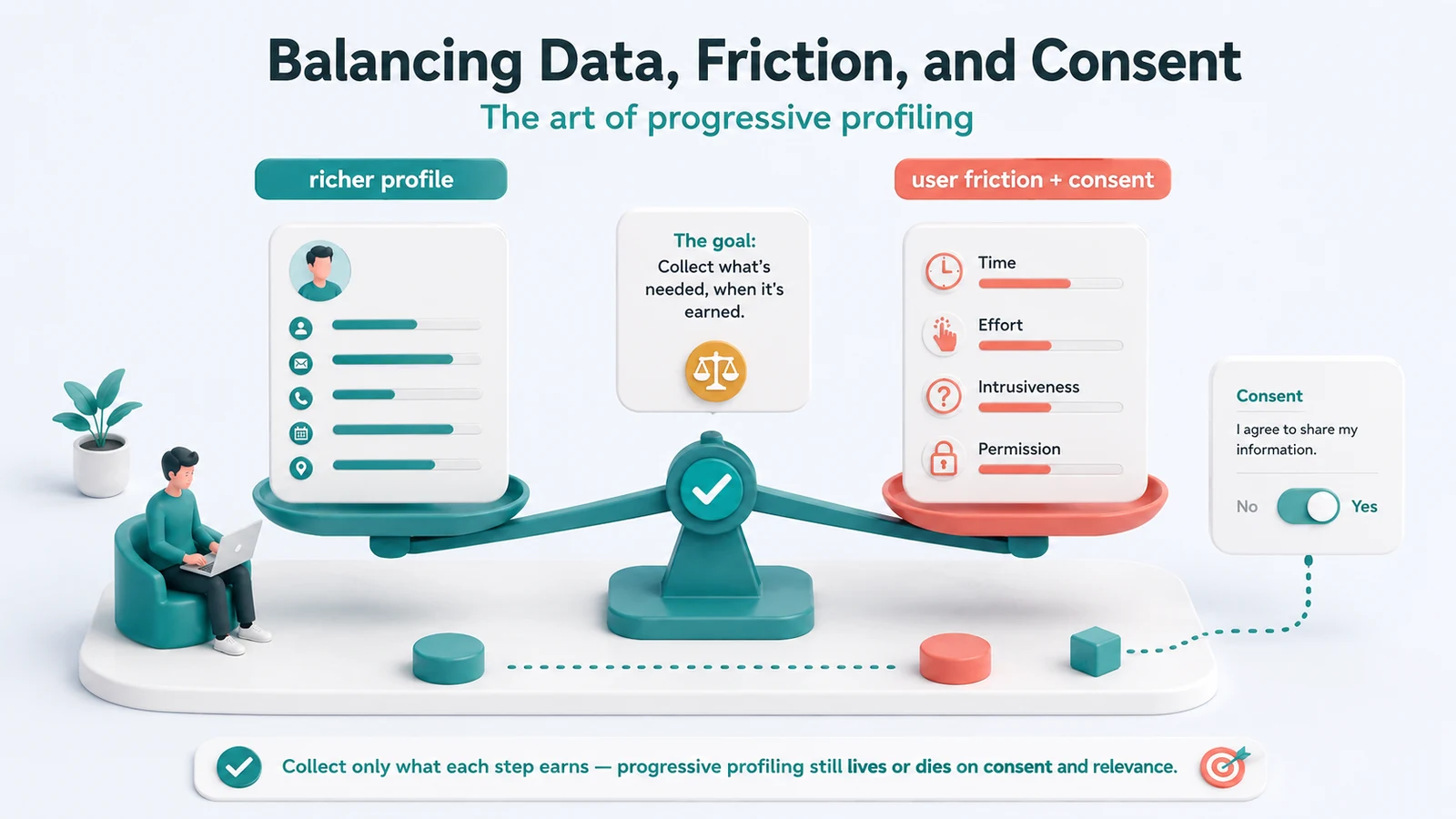 Collect only what each step earns — progressive profiling still lives or dies on consent and relevance, not on how thinly the asks are spread out.
The UX and conversion tradeoffs of not front-loading forms
The conversion argument for progressive profiling is real, but it's narrower than most pitches for the pattern suggest. Shorter initial forms measurably reduce abandonment at the first touchpoint — asking a brand-new visitor for an email address and nothing else is a smaller commitment than asking for a name, email, phone number, company, job title, and preferences before they've seen any value from the product. That much is well established and doesn't need a borrowed statistic to justify it.
Where the pattern gets oversold is in assuming staged friction is automatically better than concentrated friction. It isn't, categorically. A staged ask that interrupts a customer mid-task with no visible connection to what they're doing reads as just as intrusive as a long-form field — arguably more so, because it breaks a flow the customer thought was already finished. The cases where progressive profiling clearly outperforms a single well-designed form are the ones where each staged ask is legibly tied to a benefit: asking for a shipping address at checkout because the customer is about to need one, asking for role at the point a feature becomes role-specific, asking for notification preferences right after the customer engages with the kind of content those preferences would control. The reciprocity has to be visible in the moment, not just true somewhere in the business logic.
There's also a volume tradeoff that's easy to miss: progressive profiling trades a single conversion event (does the customer complete the form) for a series of smaller conversion events (does the customer complete this staged ask, and this one, and this one). Each of those smaller events has its own drop-off rate, and a profile that depends on five sequential staged asks to reach full completeness will, in practice, often end up less complete than a shorter single form would have produced — because not every customer returns for visit three, four, and five. The pattern shifts when incompleteness happens rather than eliminating it, which is a legitimate design choice but not a free one.
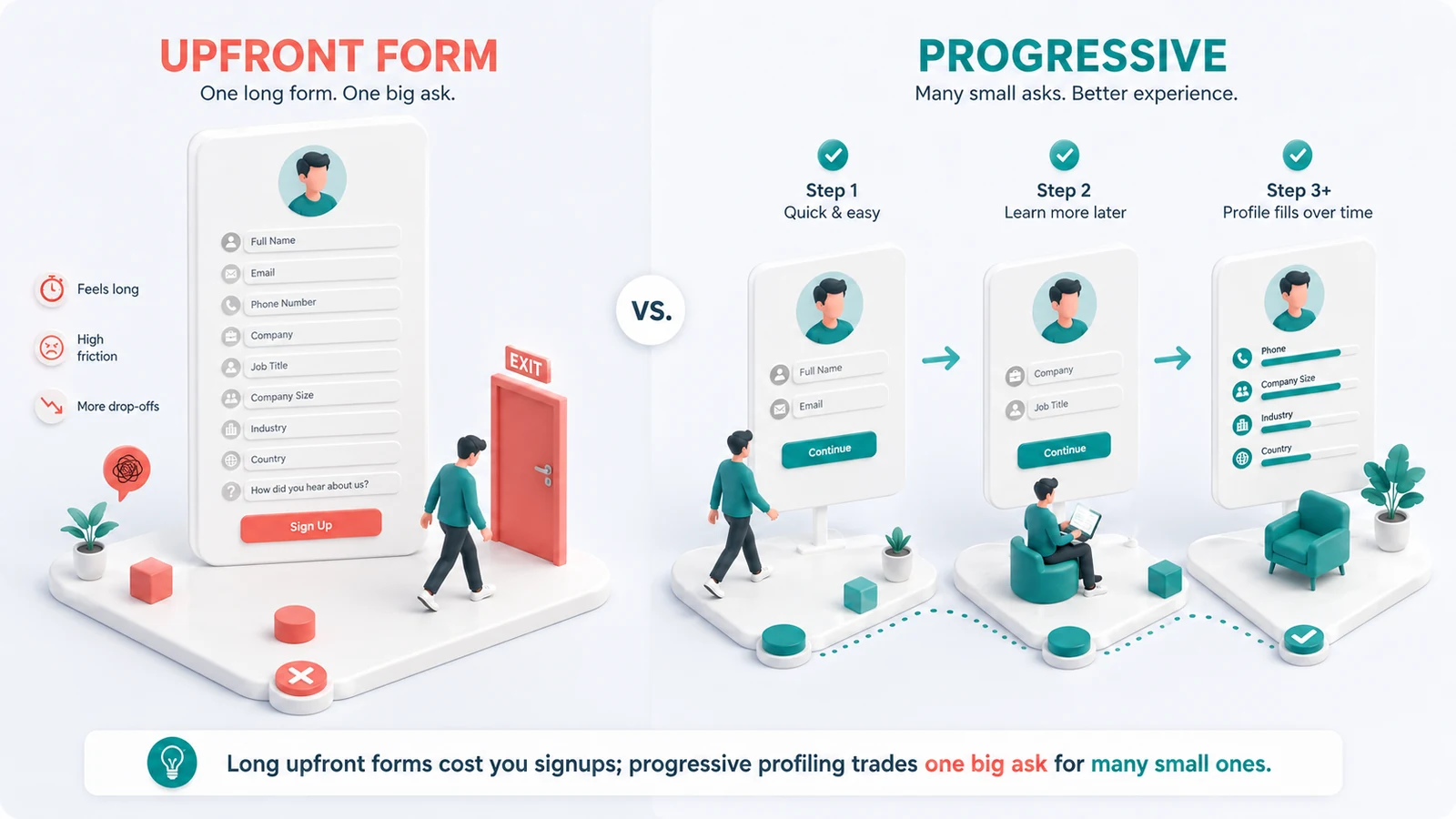 Long upfront forms cost signups; progressive profiling trades one big ask for several smaller ones — which only wins when each smaller ask feels earned.
How staged collection builds — or erodes — customer trust
The trust case for progressive profiling is the part most write-ups skip past on their way to the conversion numbers, and it's arguably the stronger argument. A single long form asks a stranger to hand over a stack of personal information before the business has demonstrated it deserves that trust. A staged approach can instead let trust and disclosure grow together: the customer gives a little, the product responds usefully, and the next ask arrives after that reciprocity has already happened once.
That sequencing matters because trust in a data relationship isn't static — it's built or spent with every interaction. A staged ask that's transparent about its purpose, easy to decline, and followed by a visible benefit reinforces the customer's sense that the business is asking for what it needs rather than what it can get away with. The same staged ask, disconnected from any purpose the customer can see, spends trust instead of building it — and because it happens repeatedly across sessions rather than once, a poorly designed progressive profiling program can erode trust more times than a single bad form ever gets the chance to.
The mechanism that ties this back to consent architecture is straightforward: a customer who can see what was asked, why, and can revoke any one piece of it without nuking the whole account is a customer who has reason to believe the relationship is honest. A customer who discovers — through a data request or a breach notice — that far more was collected than they remember agreeing to, staged or not, doesn't distinguish between "the business was slow about it" and "the business was hiding it." The staging either supports a legible, revocable consent trail or it doesn't; there's no reputational credit for having spread the same opacity across more visits.
Implementation patterns for staged collection
A handful of concrete patterns recur across working progressive profiling implementations. Session-count triggers stage asks by visit number — email only on visit one, role and company on visit two, preferences on visit three — which is simple to build but blunt, since it ignores what the customer is actually doing. Behavioral triggers stage asks based on the action a customer just took — asking for a shipping address right after they add an item to a cart — which ties the ask to visible purpose more reliably but requires more product instrumentation to get right. Feature-gated triggers ask for an attribute only when the customer reaches a feature that genuinely needs it, which is the tightest purpose binding of the three but means some customers may never be asked at all if they never touch that feature — a completeness tradeoff a team has to accept deliberately rather than discover by accident.
Whichever trigger model is used, the profile record underneath needs to support partial completeness as a normal, expected state rather than a data-quality defect. Downstream systems — personalization engines, support tooling, analytics — that assume every profile field is populated will misbehave against a progressive profile that's honestly, intentionally incomplete for a customer who hasn't hit the later stages yet. That's a schema and integration design decision as much as a consent one: null isn't always missing data, sometimes it's an accurate record of "not yet asked."
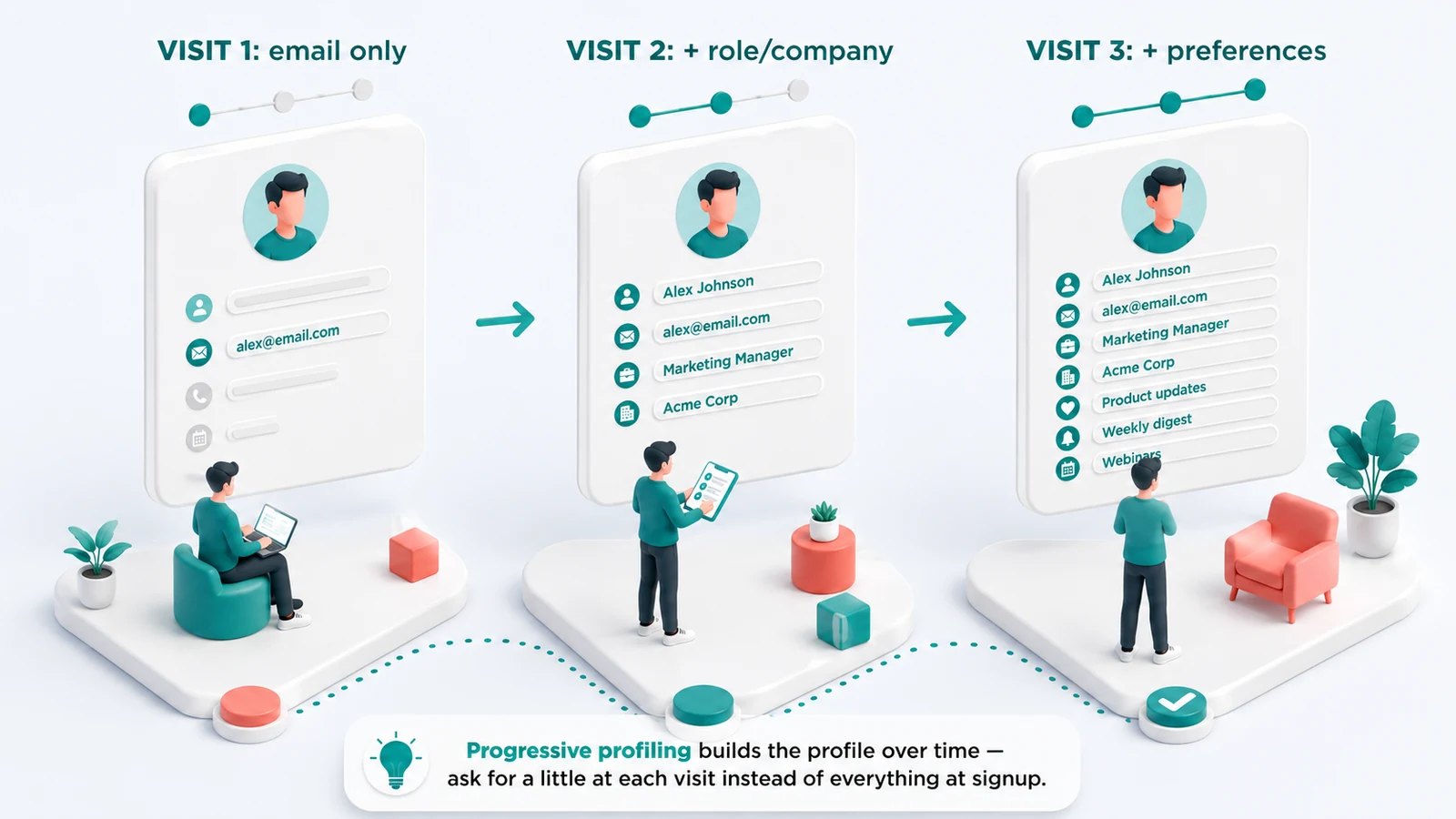 Progressive profiling builds the profile over time — ask for a little at each visit instead of everything at signup.
What Avatier ships toward this pattern
Progressive profiling as a UX and consent pattern typically lives in a CDP, marketing automation platform, or the customer-facing application itself. What Avatier Identity Anywhere contributes is the governed identity layer that pattern depends on to stay trustworthy at scale: a single, consistent profile record per customer identity that staged attribute updates write to without creating duplicate or orphaned records across systems, audit-logged consent and lifecycle events a privacy team can actually produce for a data subject access request, and policy enforcement that treats a partially complete progressive profile as an expected state rather than something downstream systems choke on.
That foundation matters more than it sounds, because the most common progressive profiling failure isn't a bad UX decision — it's a consent record that can't be reconstructed after the fact, or a profile that exists in three slightly different versions across the CDP, the support tool, and the billing system because nothing enforced a single source of truth as the attributes accumulated. The Avatier Trust Center publishes the compliance posture behind that foundation: SOC 2 Type II audited with zero exceptions noted, ISO/IEC 27001:2022 certified, PCI DSS v4.0.1 compliant, CSA STAR Level 1 attestation, NIST 800-53 Rev. 5 aligned, and a CISA Secure-by-Design Pledge signatory.
ABOUT THE AUTHOR

More from IAM & Identity Governance

Data Breaches and IAM Failures: A 2026 Post-Mortem Guide
Most identity-driven breaches follow the same chain — stolen credential, no MFA, lateral movement, exfiltration — and the controls that break that chain are well understood, if rarely fully deployed.

How AI Detects Access-Control Fraud: The 2026 Guide
AI-driven fraud detection in access control catches collusion, synthetic identities, and gamed certifications by modeling relationships and approval patterns, not just individual behavior.
What AI-Driven Provisioning Actually Does in Enterprise IAM (2026)
AI-driven provisioning replaces manual tickets and static rules with policy-based access grants triggered by HRIS and identity-graph signals — but only inside guardrails a human still has to own.