How AI Detects Access-Control Fraud: The 2026 Guide
AI-driven fraud detection in access control catches collusion, synthetic identities, and gamed certifications by modeling relationships and approval patterns, not just individual behavior.

AI-driven fraud detection in access control catches collusion, synthetic identities, and gamed certifications by modeling relationships and approval patterns, not just individual behavior.
- This piece is scoped specifically to fraud — collusion in approval workflows, synthetic identities in provisioning, gamed access-certification campaigns, and fraudulent privilege-escalation requests — not general behavioral anomaly detection. For the underlying modeling mechanism, see our ML anomaly detection piece; this one stays inside the narrower, adversarial problem of people gaming the access-control system itself.
- Fraud detection needs relationship-level signals that individual behavioral baselines don't capture: who approves whom, how often, whether approval timing clusters around audit windows, and whether a requester-approver pair's pattern deviates from what a healthy approval chain looks like.
- Synthetic identity fraud in provisioning gets caught by cross-referencing a new identity's onboarding record against everything the organization has already provisioned, not by watching what the identity does after it's live — by then the account is already real.
- False positives carry a different cost in fraud detection than in general anomaly detection. Flagging a login as unusual costs a step-up prompt. Flagging a person as gaming the system costs their standing with a manager, and the model needs a materially higher evidentiary bar and a defined investigation path before that flag goes anywhere near a human decision.
- AI fraud detection does not replace segregation-of-duties design, does not eliminate the need for human investigation once a pattern is flagged, and degrades against adversaries who learn what the model rewards and adjust their timing and phrasing accordingly.
AI detects access-control fraud by looking past individual events — a single login, a single approval — and modeling the relationships and patterns those events sit inside: who approves whose requests and how often, whether a certification reviewer is actually reading what they're certifying, and whether a newly provisioned identity's onboarding record resembles fraud attempts the organization has seen fabricated before. That's a narrower and harder problem than flagging an odd login. Fraud in access control is often collaborative — a requester and an approver working together, or an identity built specifically to pass provisioning checks — and catching it takes signals that never show up in any one person's activity log in isolation.
This is the 2026 update of an earlier Avatier piece on AI-driven access control and fraud prevention, published in 2025. That version covered access control broadly — continuous authentication, risk-based authentication, Zero Trust architecture — and leaned on statistics attributed to outside industry research to make its case. This update narrows the scope on purpose and drops the borrowed numbers. It's specifically about the subset of AI's job that is catching people gaming the access-control system itself, not detecting compromised credentials or general behavioral anomalies.
That distinction is worth stating plainly up front, because it determines which piece answers your actual question. If what you're after is how machine learning models build a behavioral baseline and score deviation from it — the general mechanism behind identity anomaly detection — that's covered in depth in our ML anomaly detection piece. This piece stays inside a narrower and more adversarial problem: access requests, approvals, and certifications that are engineered to look legitimate, rather than access events that simply look unusual.
What access-control fraud actually looks like
"Fraud" in an access-control context isn't a single pattern — it's a handful of distinct schemes that share one property: someone with legitimate standing in the system is exploiting the process, not breaking into it.
Collusion in approval workflows is the most common shape. A requester and an approver — a manager and a direct report, or two peers who agree to reciprocate — coordinate so that access gets granted without genuine scrutiny. Sometimes it's explicit quid pro quo; more often it's a manager who trusts a report enough to approve anything they ask for without reading the request, which produces the same governance gap without any conscious intent to defraud anyone.
Synthetic identity fraud in provisioning is the scheme built for automated systems specifically. Rather than compromising a real employee's account, someone constructs a plausible-looking identity — a contractor record, a service account, a temporary badge — using fabricated or stitched-together attributes designed to pass whatever provisioning checks exist, then provisions it with access that has no legitimate business owner behind it.
Gamed access-certification campaigns exploit the review process itself. Certification is supposed to be a periodic, genuine re-justification of every entitlement a person holds. In practice, reviewers under time pressure often "approve all" without reading individual lines, and a person who understands that pattern can rely on it to retain access nobody actually re-justified — access that was flagged for review specifically because it looked questionable.
Fraudulent privilege-escalation requests dress up an unjustified access grab in language that reads as routine — a project need, a temporary coverage requirement — timed to slip past an approver who's moving fast, and often timed around organizational events (a reorg, an offboarding wave, an audit window) where scrutiny is thinnest.
None of these four requires a stolen credential or a broken authentication control. That's precisely what makes them hard to catch with tools built to detect the other kind of threat.
Manual review was never built to catch this
Periodic access certification and manual approval review share a structural weakness against fraud: they sample, and fraud is patient enough to survive a sample.
A quarterly certification campaign reviews access as it stands on one day, compared against a static list of entitlements. It says nothing about how that access was granted, how quickly it was approved, or whether the same approver has cleared the same requester's escalations five times running without ever pushing back. A reviewer working through hundreds of certification lines under a deadline is, by construction, doing after-the-fact, sampled review — not because reviewers are careless, but because the format asks a human to re-adjudicate a volume of decisions no human re-adjudicates well.
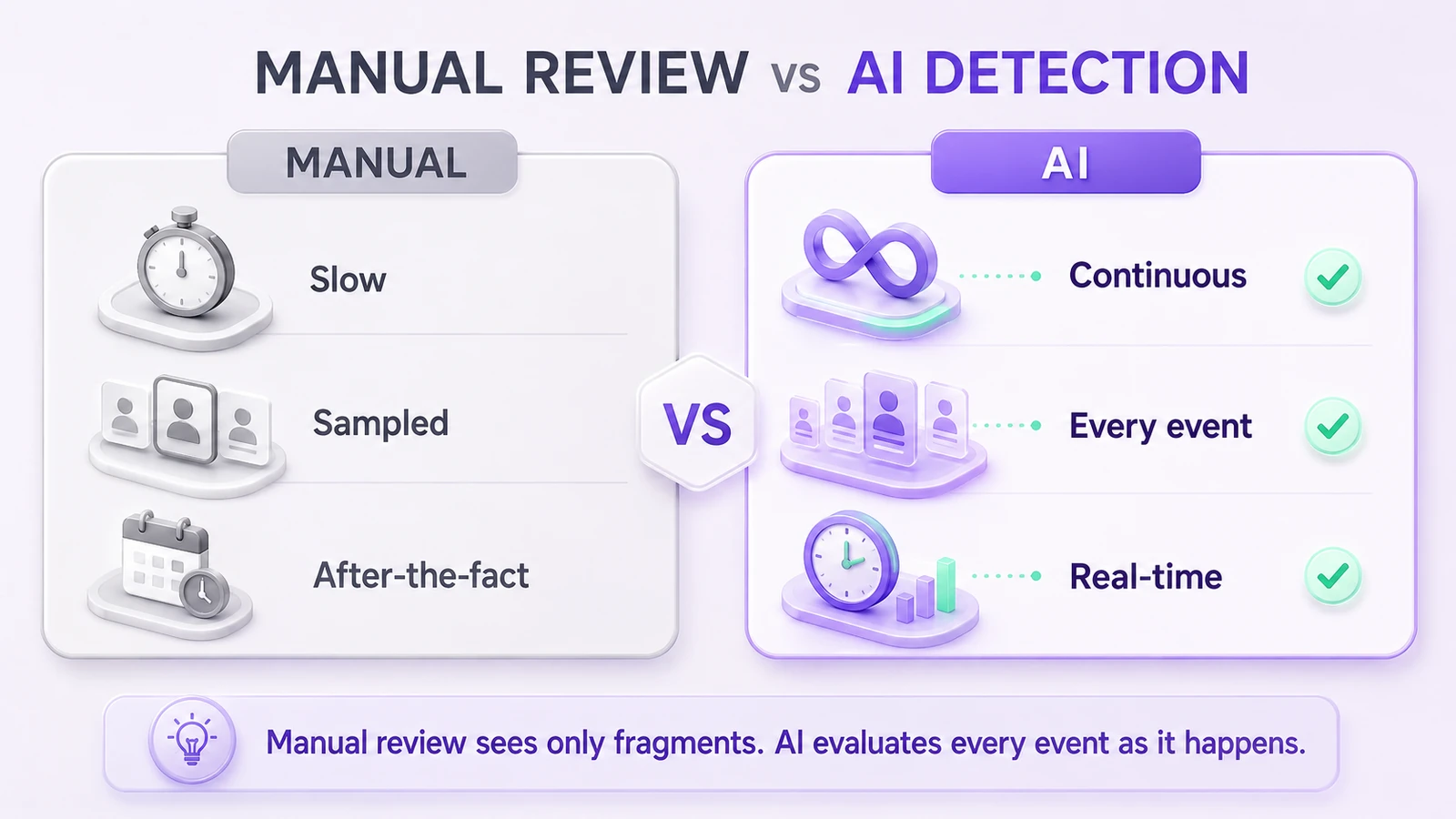 Periodic certification campaigns sample a fraction of access after the fact. Continuous scoring evaluates every request and every approval as it happens.
That's the gap AI-driven fraud detection is built to close — not by replacing certification or manual approval, but by evaluating the pattern underneath every request and every review continuously, in the same way our AI analytics for identity monitoring piece describes continuous behavioral coverage replacing sampled review elsewhere in identity — so the fraud that survives one sampled snapshot doesn't survive months of consistent behavior.
How AI models catch access-control fraud, specifically
The modeling approach for fraud diverges from general behavioral anomaly detection in one core way: fraud detection has to model relationships between people, not just deviation in one person's activity.
A collusion-detection layer builds a graph connecting requesters and approvers, weighted by how often each pairing occurs, how quickly approvals clear, and how that pairing's pattern compares to every other pairing in the same role structure. An approver who clears one specific requester's escalations in a fraction of their normal review time, or who approves at a rate for one person that's statistically far from their rate for everyone else, produces a graph anomaly — a relationship that looks different from the rest of the graph — even though no single approval in the sequence would trigger an individual behavioral flag.
Synthetic identity detection works differently again: it's an entity-resolution problem at provisioning time, not a behavioral one. The model compares a new identity's attributes — sponsor, role, documentation pattern, department — against the full population of identities already provisioned, looking for combinations that are individually unremarkable but collectively implausible, or that resemble known fabrication patterns from prior incidents. This has to happen before the identity is granted access, because a synthetic identity's behavior after provisioning is deliberately built to look unremarkable.
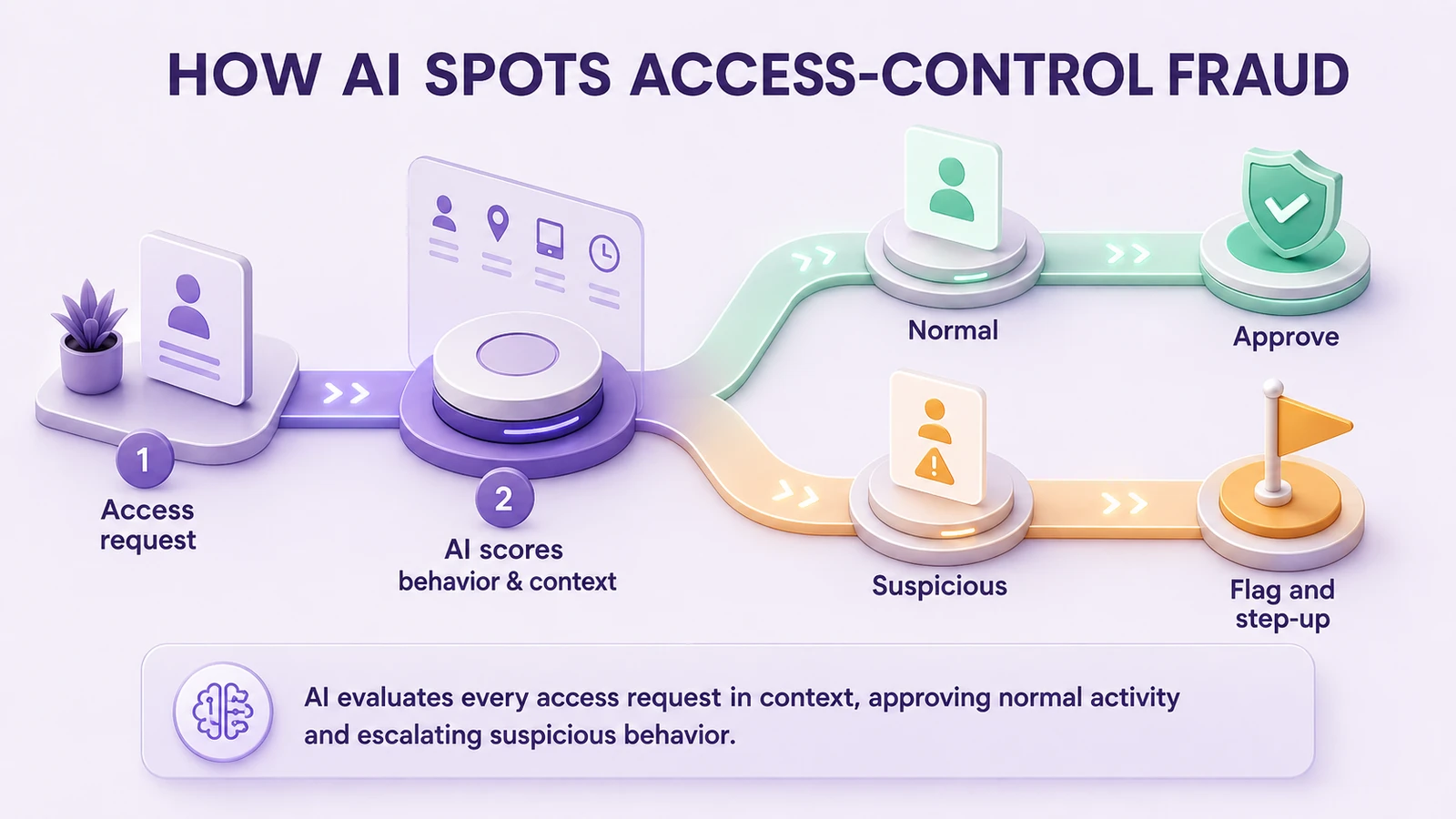 Every access request gets scored against behavior and context before it's approved — the fraud-specific layer sits on top of this, scoring the requester-approver relationship as well as the request itself.
Gamed certification detection scores the reviewer, not the entitlement. A model tracking review velocity, approval-rate variance, and whether certified entitlements later show any actual usage can distinguish a genuine, careful reviewer from one who clicks through campaigns without reading them — a distinction that requires longitudinal review-behavior data most certification tools never capture in the first place.
The signal sources that feed fraud detection
Fraud-specific detection draws on the same foundational telemetry general anomaly models use — timing, privilege change, access volume, peer comparison — but layers relationship and workflow data on top that a pure behavioral model never sees.
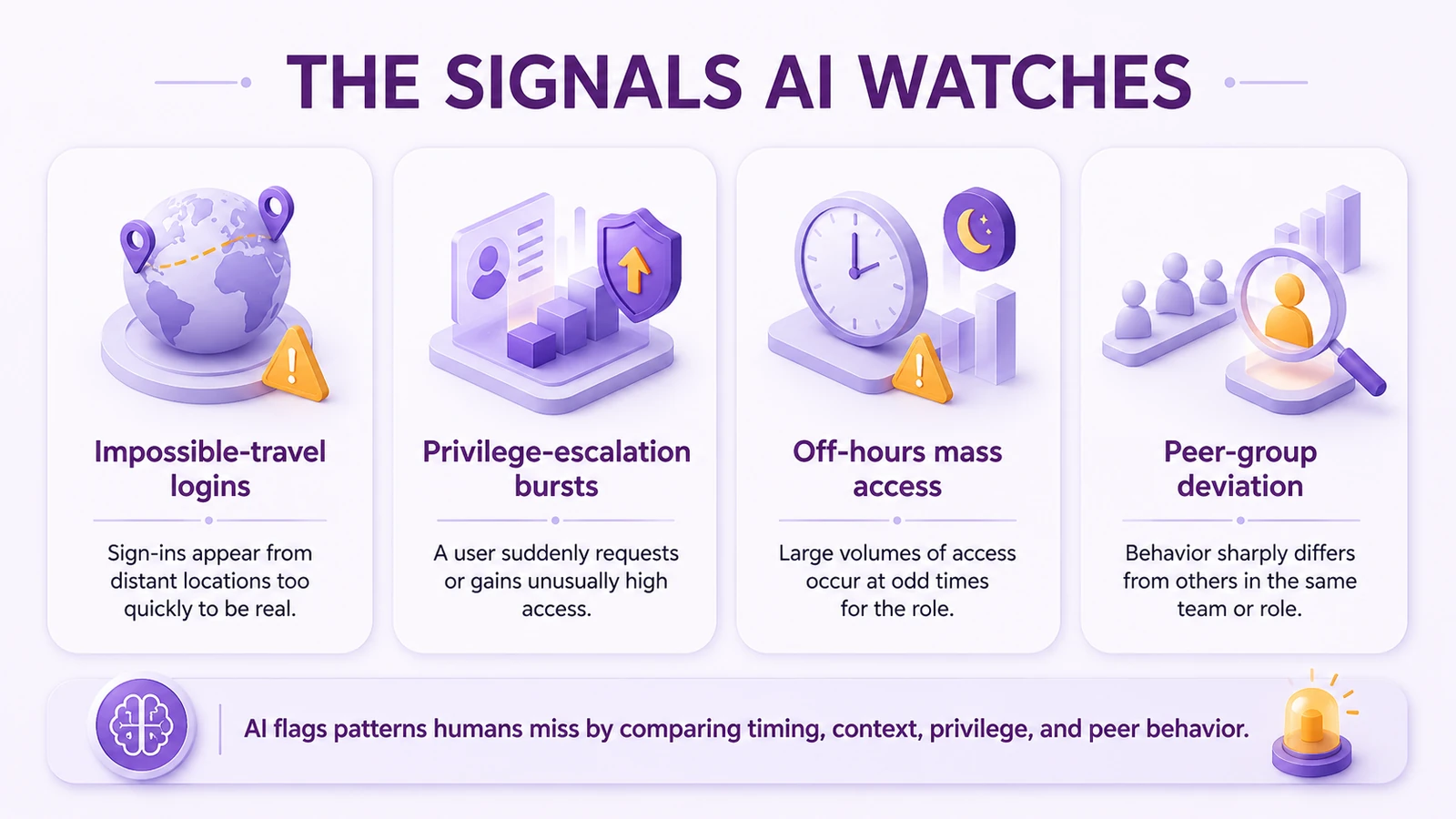 The baseline signal set — timing, privilege bursts, off-hours volume, and peer comparison — is necessary but not sufficient on its own. Fraud detection adds the relationship layer described below on top of it.
Approval-chain patterns. How long an approval takes relative to the approver's own baseline, whether an escalation skips a normally required intermediate approver, and whether an approval chain that's supposed to require two sign-offs is quietly resolving through one person acting on another's behalf.
Requester-approver relationship graphs. The pairing data described above — frequency, approval rate, and how a specific pair's pattern compares to the rest of the organization's approval graph for the same role and entitlement type.
Timing patterns around audits and organizational events. Escalation requests, certification approvals, and provisioning activity that cluster suspiciously around known audit windows, offboarding waves, or reorganizations — periods when scrutiny is structurally thinner and fraud is more likely to slip through unnoticed.
Certification review velocity and variance. How long a reviewer spends per line item, whether that time correlates at all with entitlement risk level, and whether the reviewer's approval rate for people who no longer report to them differs meaningfully from their rate for current reports.
A model missing the relationship layer can still catch a login from an implausible location. It cannot tell you that the same two people have cleared each other's escalations eleven times this year without a single rejection — and that gap is exactly what fraud-specific detection exists to close.
False positives mean something different when the accusation is fraud
Every detection system has a false-positive cost. In fraud detection, that cost lands on a person's standing rather than on a session.
A false-positive behavioral anomaly triggers a step-up authentication prompt — mildly annoying, quickly forgotten, no lasting consequence. A false-positive fraud flag implies that a specific person was colluding, fabricating an identity, or rubber-stamping reviews they should have taken seriously. Even when that flag never turns into a formal accusation, it has weight the moment a manager or an investigator sees it — reputational risk that a suppressed anomaly alert simply doesn't carry.
That asymmetry has to change how a fraud-detection program is built, not just how it's communicated. It argues for a materially higher evidentiary bar before a fraud flag reaches a human decision-maker — multiple corroborating signals over a sustained period, not a single unusual approval. It argues for a defined investigation path that treats a flag as the start of a review, not a verdict. And it argues for keeping the model's output framed as a pattern worth investigating rather than a conclusion, in the same way a fraud analyst in financial services treats a risk score as a lead, not a finding. Programs that skip this discipline either get ignored by managers who don't trust the flags, or create a due-process problem the security team didn't sign up to own.
What changes in the governance workflow
Fraud-aware detection changes more than what gets flagged — it changes how certification campaigns, approval routing, and segregation-of-duties enforcement are designed in the first place.
Certification campaigns stop being judged purely on completion rate and start being judged on review quality — velocity and approval-rate variance become metrics the governance team tracks alongside "percentage of entitlements certified," because a 100% complete campaign reviewed at two seconds per line is not the same evidence of oversight as one reviewed carefully. Approval routing gets a dynamic layer: a requester-approver pairing flagged as a graph outlier can be automatically routed to a second, independent approver rather than left to the same relationship that produced the anomaly. Segregation-of-duties rules, which are usually static — this role cannot approve for that role — get a behavioral complement, where even entitlement combinations that pass a static SoD check can still be flagged if the pattern of use looks coordinated in a way the static rule never anticipated. The same underlying risk-scoring logic our identity risk scoring piece describes for authentication and entitlement signals extends naturally to a requester-approver pairing — a relationship can carry a live risk score the same way an identity does.
None of this replaces the underlying governance controls. It makes them harder to quietly route around, which is a different and narrower claim than making fraud impossible.
What Avatier ships toward this pattern
Avatier's contribution to fraud-specific detection is upstream of the detection itself: the platform's job is making sure the data a fraud model needs — clean approval-chain history, accurate requester and approver identity, and certification records that capture who reviewed what and how — actually exists and is trustworthy in the first place. A relationship graph built on incomplete or stale approval history produces noise regardless of how sophisticated the model on top of it is.
Avatier Identity Anywhere's workflow engine captures the approval-chain metadata a collusion-detection layer needs, and AI-assisted access intelligence within the platform surfaces approval-pattern outliers and low-review-quality certification activity for a governance team to investigate — routed as leads, not verdicts, consistent with the false-positive discipline described above. Workflow automation lets a flagged requester-approver pairing get routed to a second, independent approver without waiting for a human to notice the pattern manually. The value is the governed provisioning and certification foundation any fraud-detection capability, Avatier's or a partner's, depends on for signal quality. The Avatier Trust Center publishes the platform's compliance posture: SOC 2 Type II audited with zero exceptions noted, ISO/IEC 27001:2022 certified, PCI DSS v4.0.1 compliant, CSA STAR Level 1 attestation, NIST 800-53 Rev. 5 aligned, and a CISA Secure-by-Design Pledge signatory.
ABOUT THE AUTHOR

More from IAM & Identity Governance

How ML Anomaly Detection Works for Identity: A 2026 Technical Guide
A technical walkthrough of how machine learning models actually detect identity anomalies — baselining, feature signals, unsupervised versus supervised approaches, and false-positive tuning.

Hybrid Cloud Identity Management: The 2026 On-Prem to Cloud Bridge
Hybrid cloud identity means bridging one on-prem or mainframe estate to a single cloud provider, not spanning multiple public clouds — the architecture, the failure modes, and the limits.

Data Breaches and IAM Failures: A 2026 Post-Mortem Guide
Most identity-driven breaches follow the same chain — stolen credential, no MFA, lateral movement, exfiltration — and the controls that break that chain are well understood, if rarely fully deployed.