Role-Based Access Control (RBAC): The 2026 Enterprise Guide
Role-based access control is the model that grants access through roles instead of one user at a time. This is the 2026 foundational reference — what roles, permissions, role hierarchy, least privilege, and separation of duties actually mean; where RBAC sits against ABAC, DAC, and MAC; how role explosion and role mining play out; and why banks and financial institutions lean on RBAC to enforce regulated, segregated access at scale.
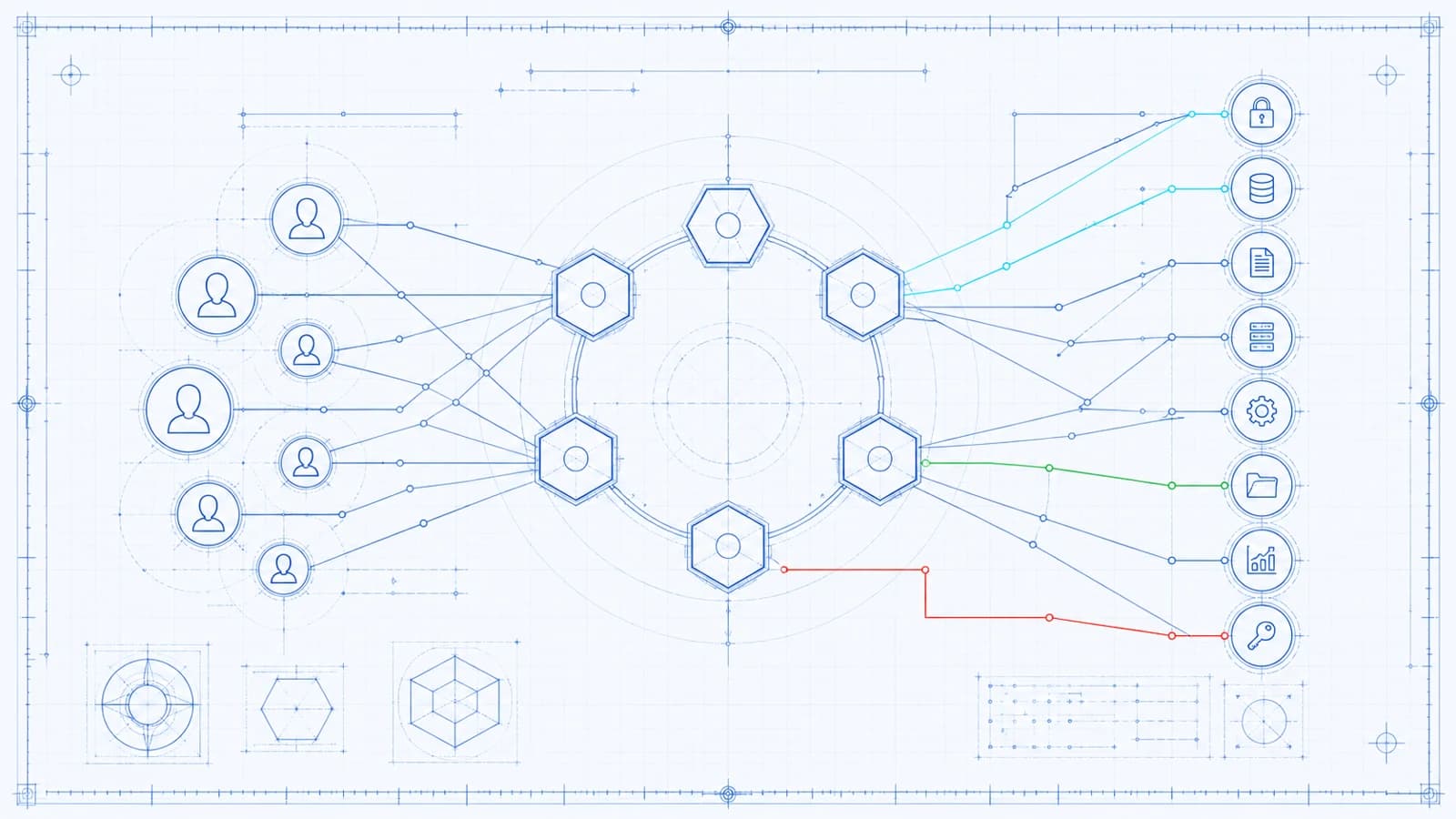
Role-based access control is the model that grants access through roles instead of one user at a time. This is the 2026 foundational reference — what roles, permissions, role hierarchy, least privilege, and separation of duties actually mean; where RBAC sits against ABAC, DAC, and MAC; how role explosion and role mining play out; and why banks and financial institutions lean on RBAC to enforce regulated, segregated access at scale.
- Role-based access control (RBAC) grants access through roles rather than one user at a time. Users are assigned to roles, roles carry permissions, and a user inherits every permission of every role they hold. That indirection is the entire point — it turns access management from thousands of individual grants into a governable set of role definitions.
- Three primitives define any RBAC system: users, roles, and permissions. A role hierarchy lets senior roles inherit the permissions of junior roles, so a 'Senior Analyst' role automatically carries everything 'Analyst' carries plus its own additions — without re-listing every permission.
- RBAC is the natural home for two access-control principles: least privilege (a role carries only the permissions its job function requires) and separation of duties (no single role can complete a sensitive transaction end-to-end). Both are enforced structurally through role design rather than case-by-case approval.
- The dominant RBAC failure mode is role explosion — role count grows until it exceeds or rivals the headcount it describes, at which point roles stop simplifying anything. Role mining (clustering users by actual entitlement usage to discover real roles) is the standard remedy; the AI-driven version of that work is covered in the companion piece and is out of scope here.
- Banking and financial services are where RBAC earns its keep. Regulated segregation of duties — the teller who cannot also approve their own adjustments, the trader who cannot settle their own trade, the loan officer who cannot approve their own loan — maps directly onto RBAC roles and mutually-exclusive role constraints, which is why access control systems for banks are almost always RBAC at the core.
Role-based access control (RBAC) is the access-control model that grants permissions to roles and then assigns users to those roles — so an individual's access is simply the sum of the permissions carried by every role they hold. Rather than granting each person access to each system one decision at a time, an administrator defines a role once, attaches the permissions that job function requires, and assigns people to it. Change what someone can do by changing their roles, not by editing hundreds of individual grants. That layer of indirection between people and permissions is the whole idea, and it is what makes access governable at enterprise scale.
This piece is the 2026 update of Avatier's original RBAC explainer (the legacy version lives at avatier.com/blog/role-based-access). It is the foundational reference: what roles, permissions, and role hierarchy actually are; how RBAC carries least privilege and separation of duties; where it sits against ABAC, DAC, and MAC; what role explosion and role mining mean; and why banking and financial-services access control systems are built on RBAC almost by default. The AI-driven companion — role mining, entitlement clustering, and predictive provisioning done with machine learning — is covered separately in the AI and Role-Based Access Control piece; this piece stays with the fundamentals.
How RBAC works: users, roles, permissions, and hierarchy
Every RBAC system is built from three primitives and one relationship between them. Users are the identities — people, and increasingly service and workload identities. Permissions are specific authorizations on specific objects: "read the general ledger," "post a journal entry," "approve a payment up to $50,000." Roles are named bundles of permissions that correspond to job functions: "Staff Accountant," "Treasury Analyst," "Branch Teller." The defining rule of RBAC is that users are assigned to roles and roles carry permissions — users are never granted raw permissions directly. A user's effective access is the union of the permissions across all roles they hold.
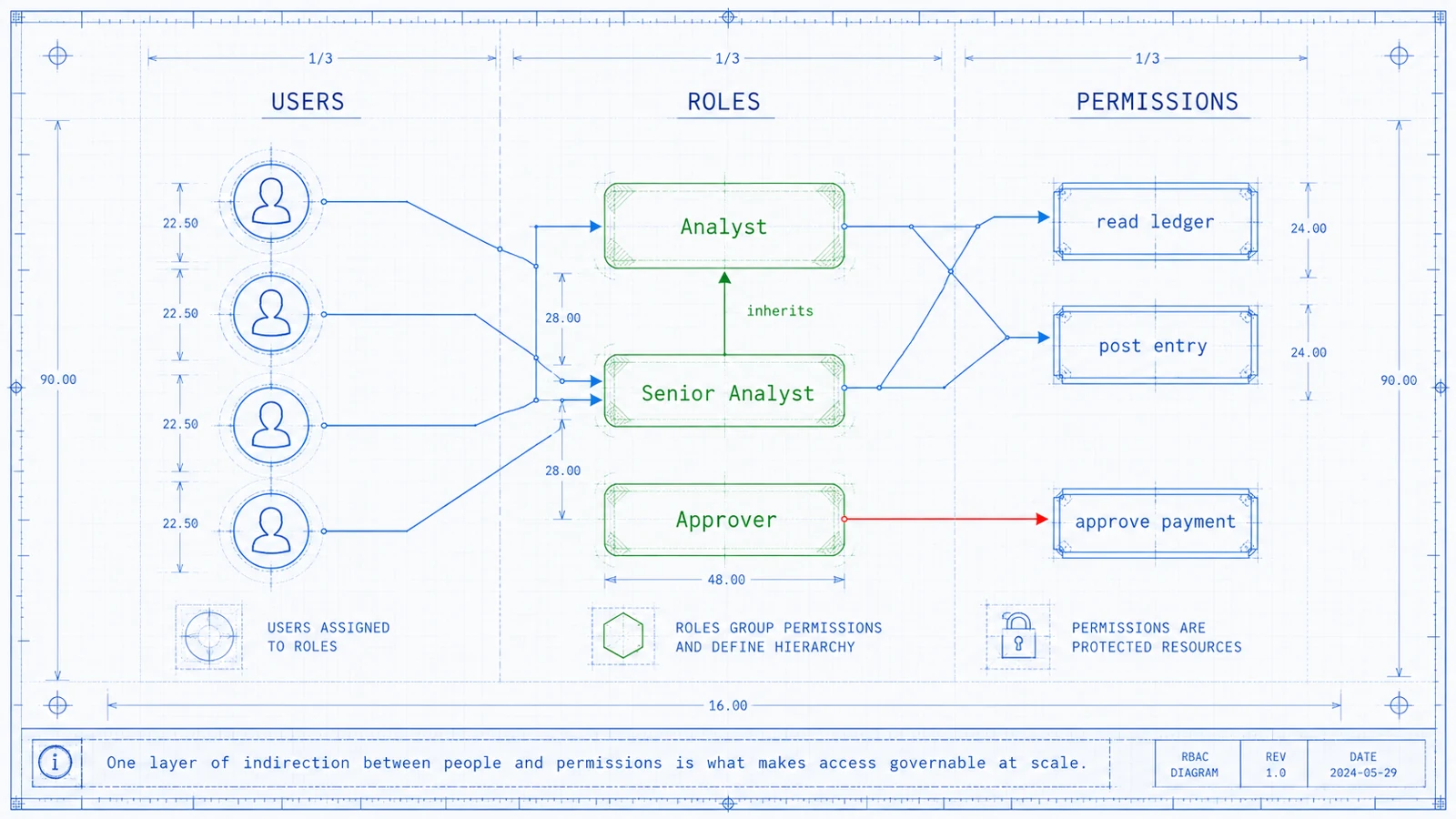 Users map to roles, roles map to permissions — and the role hierarchy lets senior roles inherit junior ones so access stays governable, not hand-assigned per person.
That indirection is why RBAC scales where per-user grants do not. Onboard a new application and you attach its permissions to the roles that need them, once, instead of granting them to every affected individual. When someone is promoted, you change their role and their access follows. The relationship between raw permissions and business roles becomes the governance surface — the thing you document, review, and audit against.
The role hierarchy is the second structural idea. Roles can inherit from one another: a senior role is defined as "everything the junior role carries, plus these additions." Define "Analyst" with ten permissions and "Senior Analyst" as inheriting Analyst plus five more, and the senior role carries fifteen without those ten being duplicated in its definition. Inheritance keeps role definitions small and internally consistent — a change to the base role propagates automatically to every role above it — and it mirrors how real organizations work, where senior functions genuinely encompass the junior ones beneath them. The discipline is to keep hierarchies shallow and functional. Deep, tangled inheritance chains reintroduce exactly the complexity RBAC exists to remove and become a quiet source of over-privilege, because nobody can hold the full inherited permission set of a five-level-deep role in their head at review time.
Formally, this is what the NIST RBAC model calls core RBAC (users, roles, permissions, sessions) plus hierarchical RBAC (the inheritance relationship). A third layer — constrained RBAC — adds the rules that make separation of duties enforceable, which is where the model gets genuinely powerful for regulated environments.
Least privilege and separation of duties
RBAC is the natural home for the two most durable principles in access control, and it is worth being precise about the relationship: the principles are goals, and RBAC is the mechanism that makes them enforceable structurally rather than case by case.
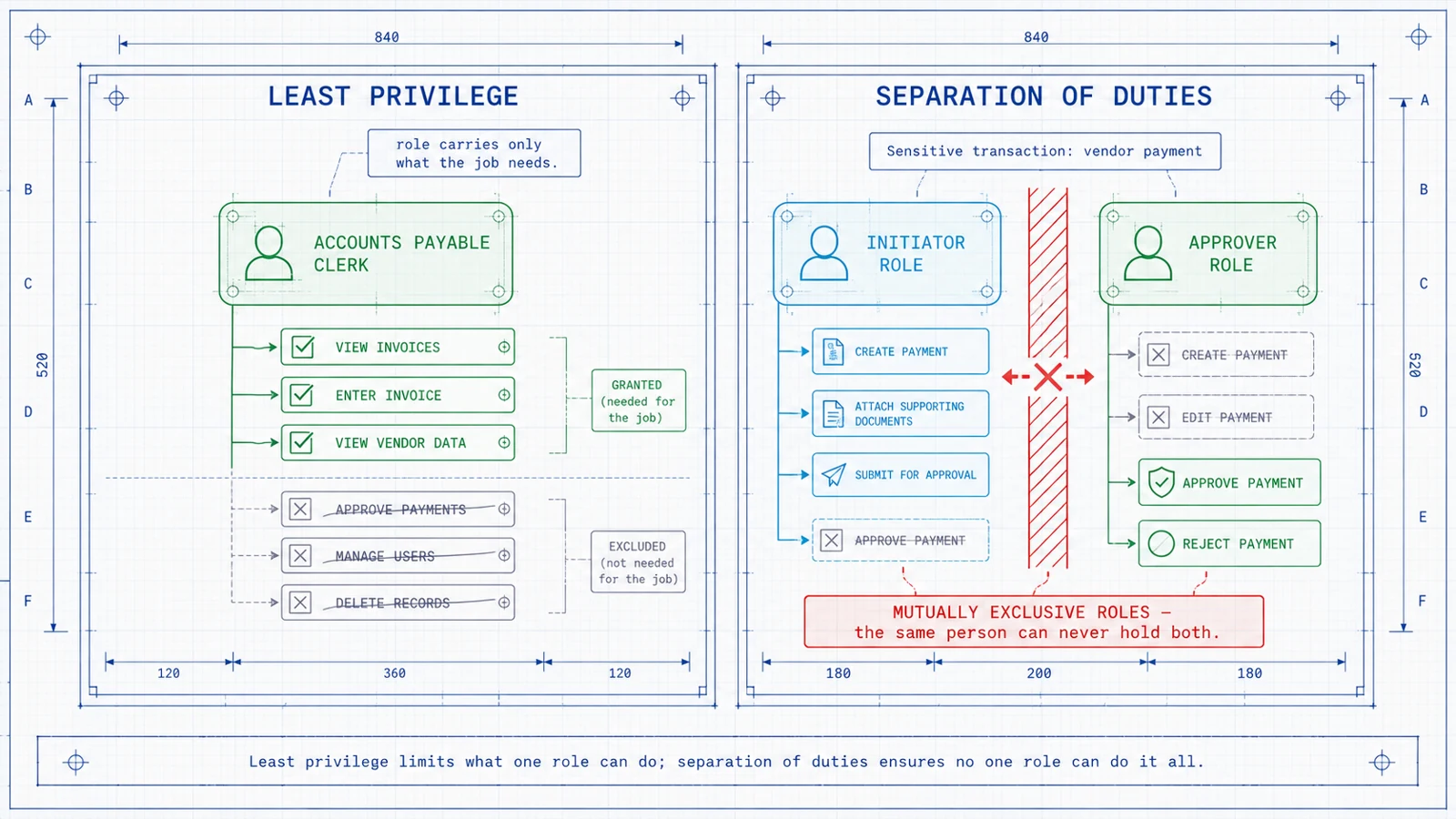 Least privilege sizes each role to its job; separation of duties splits sensitive work across roles no single person may combine. RBAC enforces both by design.
Least privilege says every identity should hold only the access its current function requires — no more. In a well-built role model, each role carries the minimum permission set its job needs, so assigning a person to the correct roles gives them exactly enough access. RBAC does not guarantee least privilege on its own; it provides the structure through which least privilege is designed and maintained. The failure modes are over-scoped roles ("add everything the department might ever touch, to be safe") and role accumulation, where a person picks up new roles across promotions and transfers while the old ones are never removed. The operational discipline that keeps least privilege real over time — mover workflows that remove as well as add, certifications that catch accumulation — is covered in the Principle of Least Privilege reference.
Separation of duties (SoD) is the control that no single identity can complete a sensitive transaction end to end. The person who initiates a payment cannot be the person who approves it; the person who creates a vendor cannot be the person who pays that vendor. In RBAC, SoD is expressed as mutually-exclusive roles — a constraint declaring that two conflicting roles may never be assigned to the same user. This is constrained RBAC in action, and it is why RBAC is the model auditors expect: the conflict is enforced by the assignment engine, not by a reviewer remembering to check. Static SoD blocks the assignment outright; dynamic SoD allows a user to hold conflicting roles but never to activate both in the same session. Either way, the segregation is structural.
RBAC vs ABAC vs DAC and MAC
RBAC is one of several access-control models, and the useful comparison is against the three it most often gets set beside.
DAC (discretionary access control) lets resource owners grant access at their own discretion — the file owner decides who can read the file. It is flexible and it is how most operating-system file permissions work, but it does not scale to enterprise governance: access decisions are scattered across thousands of individual owners with no central role model to audit. MAC (mandatory access control) enforces access through system-wide policy and security labels (classifications like Secret and Top Secret) that individual users cannot override; it is the model of high-assurance government and military systems. The tradeoffs between owner discretion and mandatory policy — and why neither is a complete enterprise answer alone — are covered in the Mandatory vs Discretionary Access Control piece.
ABAC (attribute-based access control) is the model most often compared with RBAC today, and the comparison matters. RBAC grants access based on the roles a user holds. ABAC grants access by evaluating attributes — of the user, the resource, and the request context — against policy rules at the moment of the request. RBAC answers "what roles does this person have?" ABAC answers "does this request satisfy policy, given who is asking, what they want, and under what conditions?" RBAC is simpler to reason about, cleaner to audit, and maps directly to job functions, which is why it dominates enterprise and banking access. ABAC handles the fine-grained, context-dependent decisions RBAC struggles to express — time of day, geographic location, transaction amount, data-sensitivity level, device posture. In practice the two are layers, not rivals: mature 2026 architectures use RBAC to set the coarse baseline of access by job function, then layer ABAC conditions on top for the context-sensitive cases. The role sets the floor; the attributes constrain the exceptions.
Role explosion and role mining
The characteristic way RBAC goes wrong is role explosion: the number of roles grows until it approaches, or exceeds, the number of users it is supposed to describe. It happens the same way every time — a request comes in that doesn't fit an existing role, and instead of composing existing roles or adding a constraint, someone creates a new bespoke role. Repeat for a few years and the catalog has thousands of roles, many held by a single person, many differing from one another by one permission. At that point roles have stopped simplifying anything; you are managing access one identity at a time again, just with a role-shaped layer of overhead on top. Role explosion is the clearest signal that a role model has drifted away from job functions and toward individual history.
The standard remedy is role mining: analyzing which identities actually hold which entitlements, clustering users by real usage patterns, and consolidating the sprawl into a smaller set of roles that reflect genuine, shared job functions. Done well, role mining replaces a catalog that grew by accretion with one that reflects how people actually work. Done on unclean data, it faithfully reproduces the existing mess as tidy-looking roles — which is the central caution. Prevention beats cure: assign every role a business owner, recertify roles and assignments on a schedule, and bias hard toward reusing and composing existing roles rather than minting new ones. The machine-learning version of this work — unsupervised clustering, entitlement analytics, predictive provisioning, and where human judgment has to stay in the loop — is the subject of the AI-driven companion, the AI and Role-Based Access Control piece, and is deliberately out of scope here. This piece is the foundation that the AI work sits on top of; the model has to be sound before analytics can help maintain it.
RBAC in banking and financial services
Banking and financial services are where RBAC stops being a convenience and becomes a regulatory necessity. Financial institutions run on access decisions that must be provably segregated, provably minimal, and provably reviewable — and RBAC is the model that expresses all three against a documented catalog an examiner can audit. This is the reason "access control system for banks" and "access management in banking" resolve, almost universally, to RBAC at the core.
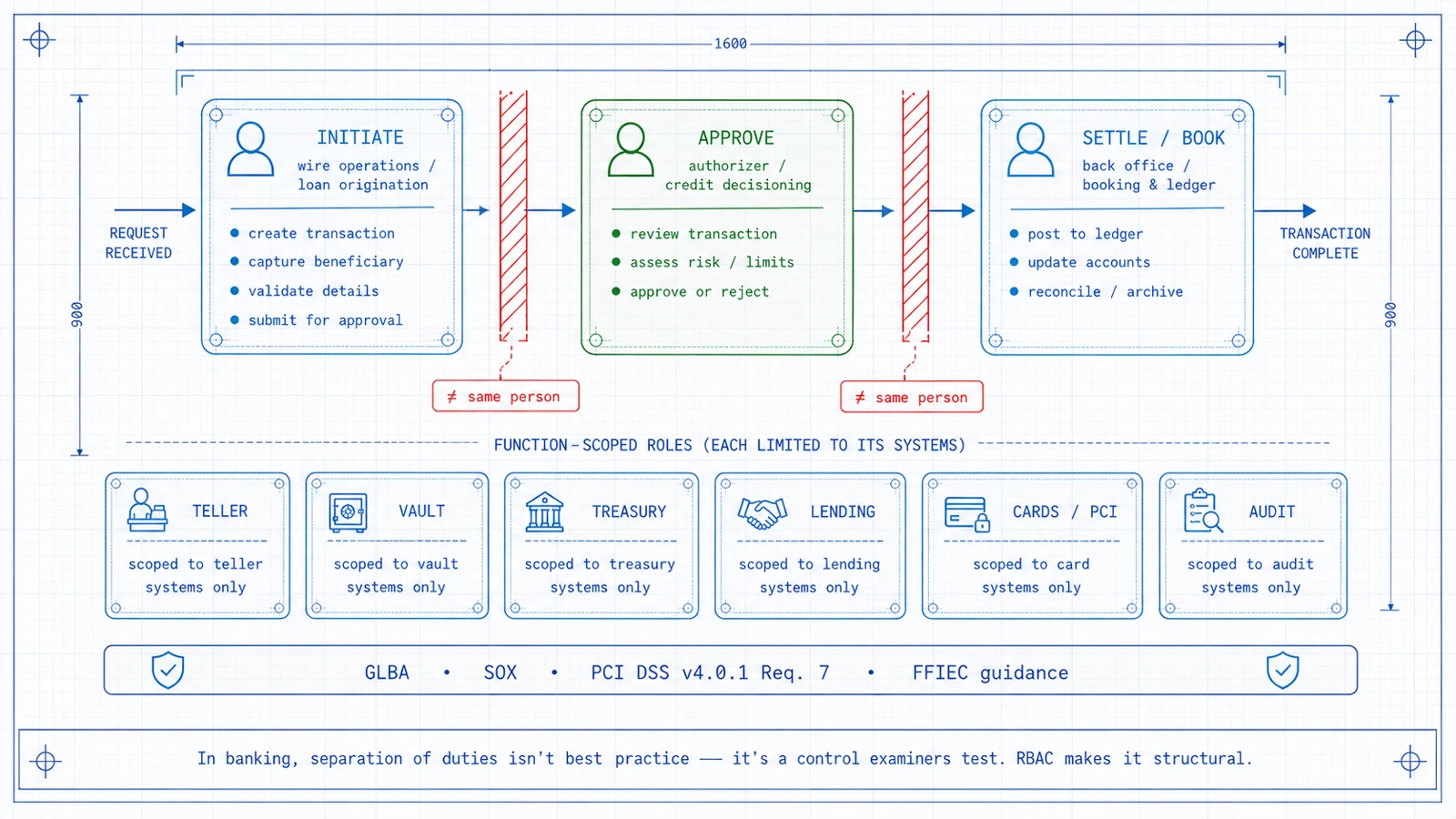 In banking, RBAC turns segregation of duties into structure: initiation, approval, and settlement live in separate roles no one identity may combine — exactly what examiners test.
Consider the concrete patterns. A teller role grants cash-drawer and routine account operations but not the ability to approve adjustments to their own transactions — that authority lives in a supervisor role, and the two are mutually exclusive. In wire operations, the identity that initiates a payment cannot hold the role that authorizes it; large transfers route through a maker-checker split enforced as constrained RBAC. In lending, the loan officer who originates a loan cannot hold the role that approves it, keeping origination and credit decisioning in separate hands. In trading and treasury, the front-office role that executes a trade is separated from the back-office role that settles and books it — the classic control that exists specifically because combining those functions is how rogue-trading losses happen. Each of these is a segregation-of-duties requirement, and each maps cleanly onto RBAC roles plus mutual-exclusion constraints.
The regulatory frameworks reinforce the model without prescribing a specific product. The Gramm-Leach-Bliley Act (GLBA) requires financial institutions to protect customer data, which in practice means access restricted by role and business need. The Sarbanes-Oxley Act (SOX) makes segregation of duties over financial-reporting systems an audited control. PCI DSS v4.0.1 Requirement 7 mandates that access to cardholder data be restricted by business need-to-know and assigned by job classification — a direct description of role-based assignment. FFIEC examination guidance expects documented, least-privilege, role-appropriate access across banking systems. None of these regulations say "use RBAC" by name, but all of them describe controls that RBAC is the cleanest way to implement and evidence. When context-sensitive controls are needed on top — step-up authentication on a high-value or anomalous transaction — that is where risk-based, adaptive layers come in, as covered in the Adaptive Authentication and Risk-Based MFA piece on ICC.
Because banking roles change constantly — transfers, promotions, new product lines — the role model stays clean only if lifecycle and certification run continuously behind it, which is where access governance enters the picture.
Implementing RBAC
Standing up RBAC well is more about sequence and ownership than about technology. The pattern that holds up:
Start from job functions, not from systems. Derive roles from what people actually do, then validate those definitions against real entitlement data rather than trusting the org chart, which describes reporting lines, not access needs. Roles designed purely top-down tend to describe titles; roles validated bottom-up against usage describe work.
Design roles for least privilege from the start. Each role should carry the minimum its function requires. Resist the "add everything they might need" reflex — it is the origin of most over-privilege that audits later surface.
Build separation-of-duties constraints in early. Identify the conflicting function pairs — initiate/approve, create/pay, execute/settle — and encode them as mutually-exclusive roles before the assignments pile up. Retrofitting SoD onto an existing tangle of assignments is painful; designing it in is straightforward.
Assign every role an owner. A role without a named business owner is a role nobody will keep honest. Ownership is what makes recertification meaningful and what prevents role explosion, because an owner is accountable for whether a new role is really needed.
Drive assignment from lifecycle events. Joiners get baseline roles automatically from HR data; movers have prior-role access removed as new-role access is added; leavers are deprovisioned promptly. RBAC delivers its value only when role assignment is wired to authoritative lifecycle events rather than to manual tickets. For high-privilege roles, pair standing RBAC with just-in-time elevation so that sensitive access is requested and time-boxed rather than always-on — the pattern in the Just-in-Time Access piece and, for administrative accounts, the Privileged Access Management piece.
Recertify on a schedule. Roles and their assignments both need periodic review — do these roles still reflect real functions, and does each person still need the roles they hold? Certification is what catches the drift that even good lifecycle automation lets through. This lifecycle-plus-certification wrapper around the role model is precisely the discipline covered in the Access Governance for Modern Identity Security piece.
What Avatier ships toward this pattern
Avatier Identity Anywhere is built around a governable role model rather than a pile of point grants. Roles and entitlements live in a catalog that business owners can see and reason about; access requests flow through approval workflows tied to that catalog; and assignment is driven by lifecycle events from authoritative HR sources, so joiners land in the right roles, movers have stale roles removed as new ones are added, and leavers are deprovisioned on a defensible timeline. Separation-of-duties constraints are enforced at assignment time, which is what turns an SoD policy from a document into a control — the conflicting roles simply cannot be combined on one identity. Certification campaigns run against the same catalog so that over-privilege and role accumulation surface at review rather than at audit, keeping the role model aligned to real job functions over time.
For regulated customers, the point is that the whole thing is auditable against a documented role model — the artifact examiners actually ask for. Avatier's own control posture is published at the Avatier Trust Center: SOC 2 Type II with zero exceptions, ISO/IEC 27001:2022 certified, PCI DSS v4.0.1 compliant, CSA STAR Level 1, NIST 800-53 Rev. 5 aligned, FedRAMP-aligned, FIDO2-compatible, and a signatory of the CISA Secure-by-Design Pledge. The role model is the schema; Avatier's governance layer is the process that keeps it honest.
ABOUT THE AUTHOR

More from Access Management

Is SAML 2.0 Still Relevant in 2026? An Honest Assessment
An honest 2026 assessment of SAML 2.0 — where it remains the right answer (legacy enterprise SSO, B2B federation), where OIDC has won, and how to harden and migrate what stays.
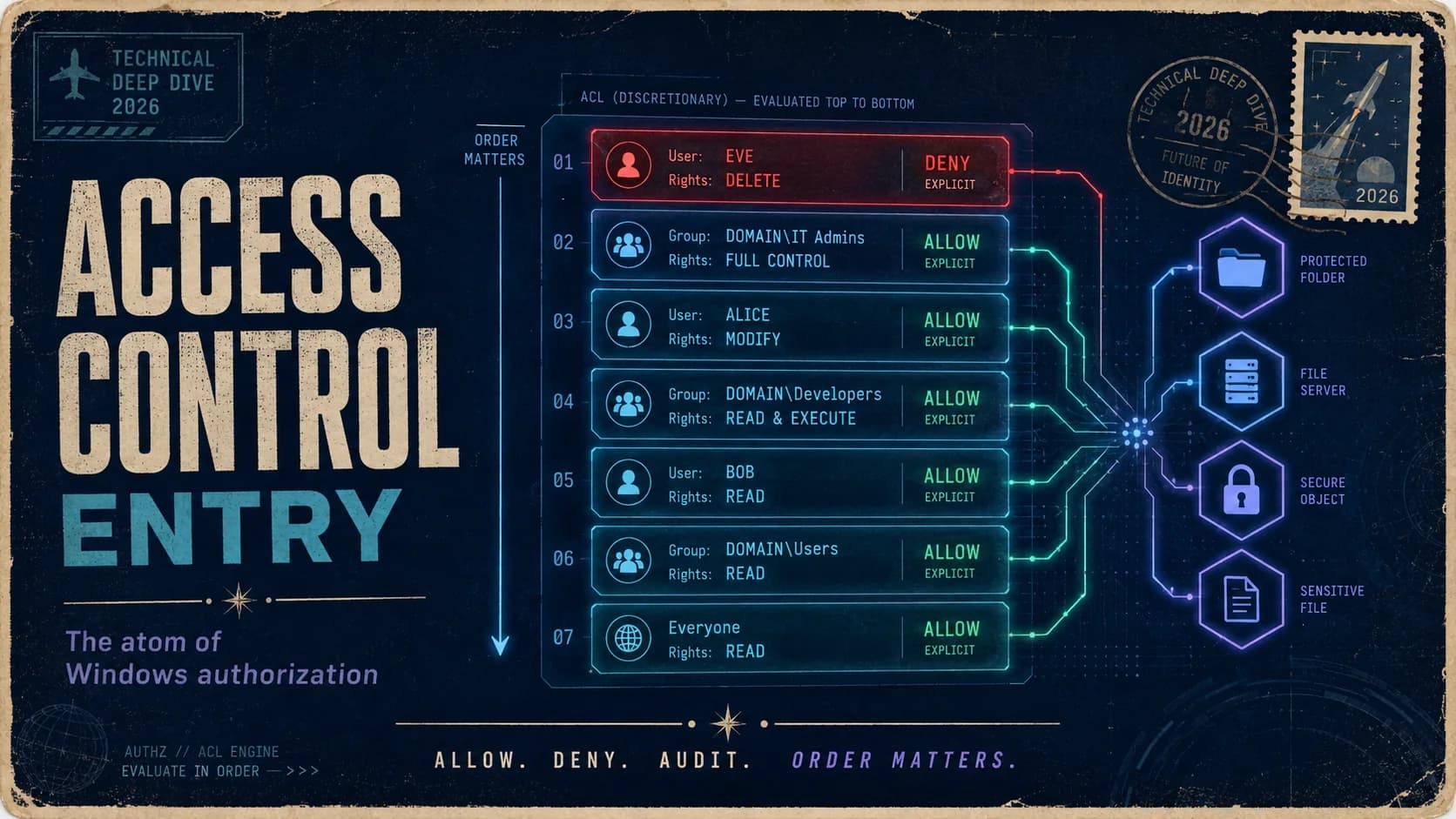
Access Control Entry (ACE) Explained: A Technical Deep Dive for 2026
An access control entry is the smallest unit of authorization in Windows security — one trustee, one set of rights, one allow/deny/audit verdict. The 2026 technical reference: ACE anatomy, DACL vs SACL, canonical evaluation order, inheritance flags, POSIX and cloud analogues, and where ACL-based control breaks at enterprise scale.

Enterprise RBAC Implementation: Best Practices for 2026
The operational companion to the RBAC fundamentals reference — how to actually implement enterprise role-based access control well. Rollout sequencing, role design that avoids explosion, least-privilege enforcement in practice, entitlement modeling, provisioning integration, access reviews, and the pitfalls that sink real programs.