Password Reset Questions & Help-Desk Best Practices (2026)
Static security questions are the weakest link in password reset — OSINT-discoverable, shared, and breach-exposed. The 2026 best practice: retire them for MFA-verified self-service reset.
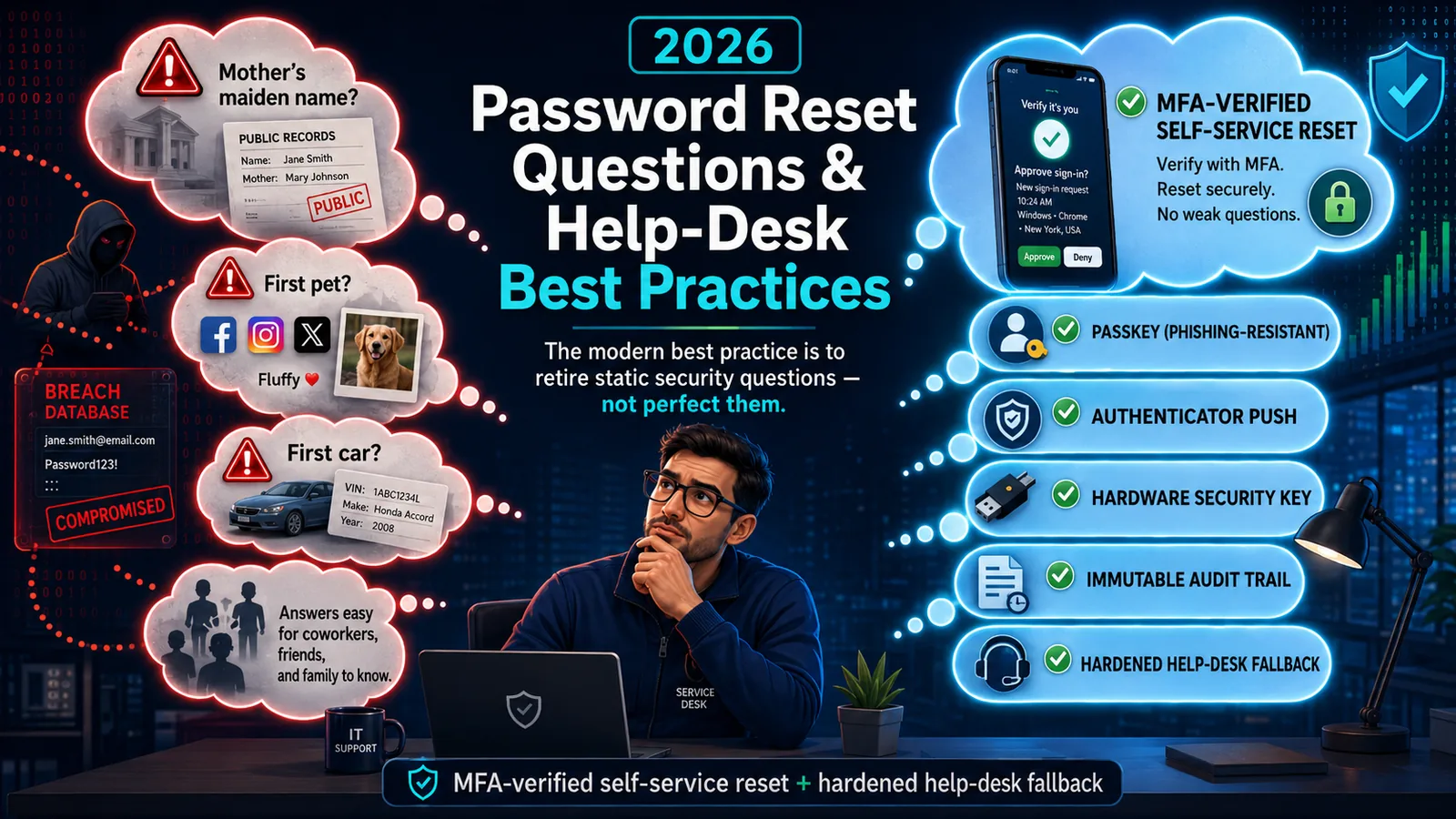
Static security questions are the weakest link in password reset — OSINT-discoverable, shared, and breach-exposed. The 2026 best practice: retire them for MFA-verified self-service reset.
- The single best practice for password reset security questions in 2026 is to stop treating them as a verification factor. Static knowledge-based answers — maiden name, first pet, first car — are discoverable through open-source intelligence, shared with family and colleagues, guessable from a short list of common values, and exposed in prior breach dumps. They verify who knows a fact, not who the person is.
- NIST SP 800-63B guidance discourages knowledge-based authenticators for identity verification. The federal framework treats memorized static answers as a weak, deprecated mechanism because the entropy is low and the answers are recoverable by an attacker. This is a public framework position, not a vendor claim — and it has shaped how mature reset programs are now built.
- The 2026 target pattern is MFA-verified self-service reset plus a hardened help-desk fallback. Move routine resets to a self-service portal gated by a strong factor (authenticator push, passkey, hardware key), and constrain the help-desk path so an agent can trigger a reset out-of-band without ever learning or setting the new secret.
- Help-desk password reset best practices center on four controls: verify identity out-of-band, keep agent action least-privilege, log every reset to an immutable audit trail, and issue a one-time temporary credential with forced change. These make the assisted path defensible under SOC 2, PCI DSS, and HIPAA audit without relying on security questions.
- The honest residual risk is help-desk social engineering. Even a well-built reset flow carries a human failure mode: an attacker who impersonates a user to a live agent. Out-of-band verification, least-privilege tooling, callback policies, and audit visibility reduce it — but no reset program eliminates it entirely, which is why passwordless coverage is the long-term direction.
The best practice for password reset security questions in 2026 is, increasingly, to stop using them as a verification factor. Static knowledge-based answers — mother's maiden name, first pet, the street you grew up on — were designed for an era before social media, data brokers, and mass credential breaches made those answers trivially discoverable. Today they verify who knows a fact, not who a person is. If you run a help desk or own a password reset flow, the highest-impact move is to shift routine resets to MFA-verified self-service and constrain the help-desk fallback so no single guessable answer can unlock an account. This piece covers why static questions fail, what stronger verification looks like, the specific help-desk controls that hold up under audit, and a realistic path off security questions.
This is the 2026 update of an earlier Avatier post, 7 Best Practices for Password Reset Questions. The original framed the problem as choosing better questions and limiting attempts — reasonable advice for its time. The guidance has since moved: the modern consensus, reflected in public standards, is that the security-question model itself is the weak link, and the work is to retire it rather than optimize it. We have kept the operational spirit of the original — make reset easy, limit abuse, layer verification — but pointed it at the mechanisms that actually resist today's attacks.
Why static security questions became a liability
The failure of security questions is structural, not a matter of picking better prompts. Their entire security model rests on a secret that is supposed to be known only to the user. In practice, the "secret" is a fact about the user's life, and facts about people's lives are among the most widely available data in the world.
Four properties make them untrustworthy as a reset factor. The answers are OSINT-discoverable — open-source intelligence pulls maiden names, birthplaces, schools, and family details from social profiles, public records, obituaries, and people-search sites. They are socially shared — spouses, family, and close colleagues routinely know the answers, and phishing pages or shoulder-surfing capture them directly. They are guessable and low-entropy — self-chosen answers cluster around a small set of common values (a handful of favorite colors and sports teams cover a large share of any population). And they are breach-exposed — historical question-and-answer dumps and credential breaches have leaked reused answers that users almost never rotate.
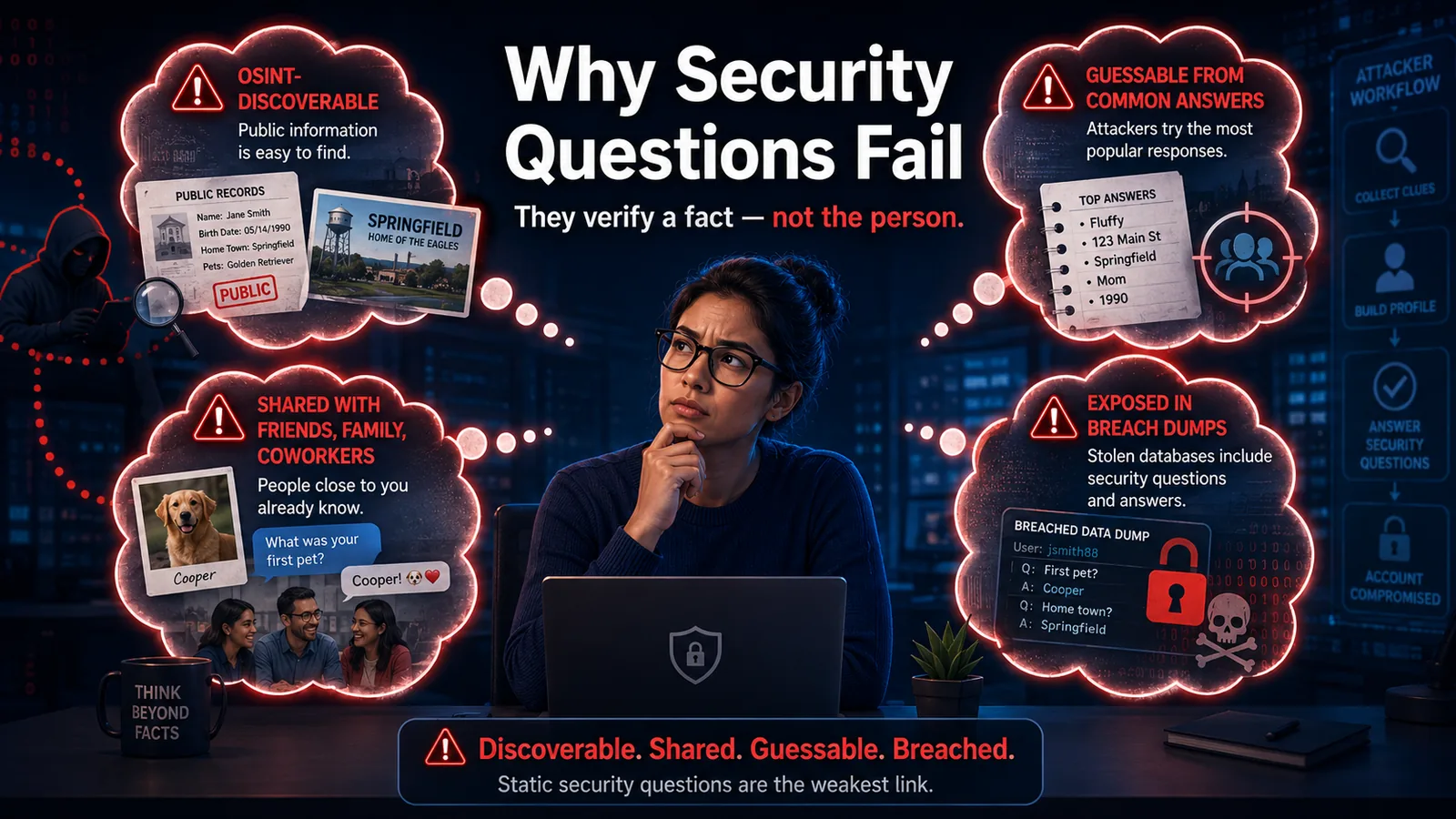 Static security questions verify knowledge of a fact, not identity — and every fact they rely on is discoverable, shared, guessable, or already breached.
The deeper problem is that all four properties compound. An attacker researching a targeted account does not need to defeat the question — they only need to find the answer, and the answer is usually recorded somewhere public or purchasable. This is why account-takeover playbooks so often route through the reset flow rather than the login screen: the reset path frequently has weaker verification than the primary authentication it protects. A password policy that enforces length and complexity (the risks of weak passwords covers why that matters) is undermined entirely if the recovery path accepts a mother's maiden name.
There is a usability failure layered on top of the security one, and it quietly drives cost. Users forget their own answers as often as they forget passwords — they capitalize inconsistently, abbreviate differently than they did at enrollment, or genuinely cannot recall which of several possible "first cars" they entered. When self-service verification hinges on matching a free-text answer exactly, a meaningful share of legitimate users fail it and fall through to the help desk. So security questions manage the rare feat of being simultaneously too weak to stop an attacker and too brittle to reliably admit the real user. The controls that replace them — possession of an enrolled device, a passkey, a biometric — are both harder to forge and easier for the genuine user to satisfy on the first attempt.
What NIST SP 800-63B says about knowledge-based authenticators
The shift away from security questions is not just industry opinion — it is reflected in the federal digital identity guidance. NIST SP 800-63B guidance discourages knowledge-based authenticators for identity verification. The reasoning is direct: memorized static answers carry low entropy and are recoverable by an attacker, so they do not provide meaningful assurance that a person is who they claim to be.
It is worth being precise about what this is and is not. It is a public standards framework describing how to think about authentication assurance — anyone can read it, and it applies broadly, not to any one vendor's product. It is not a certification that a specific tool has passed, and this piece makes no such attestation. What the guidance does provide is a shared, defensible reference point: when a security team tells leadership or an auditor that security-question reset is being retired, "the federal identity framework treats knowledge-based answers as a deprecated mechanism" is a stronger argument than internal preference.
Practically, the guidance nudges programs toward two factor categories that resist the attacks against knowledge-based answers: possession (something the user holds — an enrolled phone running an authenticator, a passkey, a FIDO2-compatible hardware key) and biometric (something the user is, verified locally on a trusted device). Neither is discoverable through research, shareable in the way a fact is, or dumpable in a breach in a form an attacker can reuse. That is the whole point of moving off knowledge-based verification.
The verification ladder: from guessable knowledge to cryptographic proof
Not every alternative to security questions is equally strong, and pretending otherwise leads to a false sense of progress. It helps to picture reset verification as a ladder, from the weakest knowledge-based factor to phishing-resistant cryptographic proof, and to know which rung a given control actually sits on.
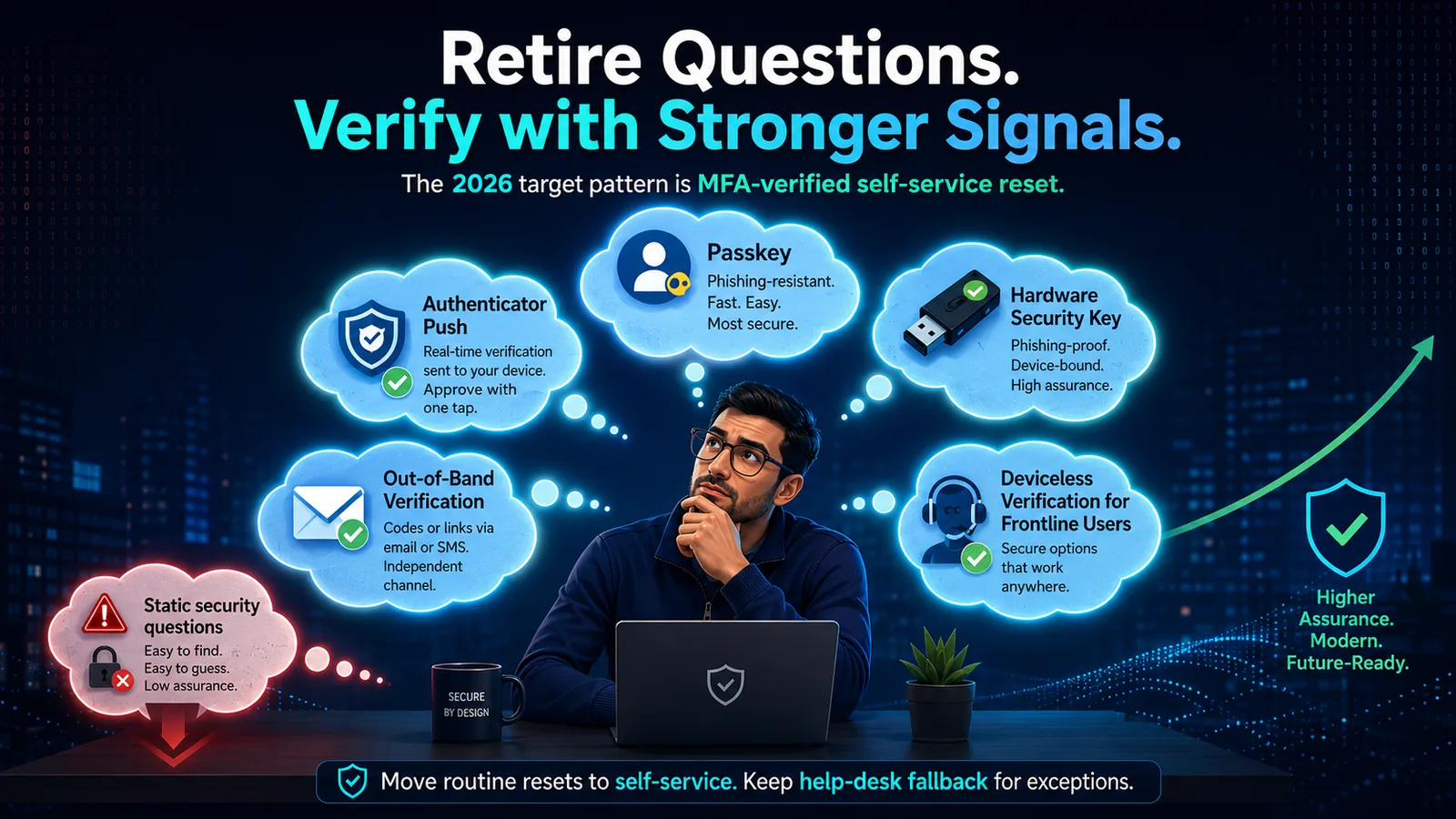 Move routine resets onto stronger signals — push, passkeys, hardware keys, out-of-band codes, deviceless verification — and leave static questions behind at the bottom. Keep a hardened help-desk path for the exceptions.
At the bottom sit static security questions — shared secrets, OSINT-exposed, the factor this piece argues to retire. One rung up, SMS or email one-time codes are a genuine improvement because they require access to a channel rather than knowledge of a fact, but they carry their own weaknesses: SMS is vulnerable to SIM-swap, and both channels can be phished in real time by a convincing lookalike page. They are acceptable as a fallback, not as the primary factor for sensitive accounts.
Higher up, app push and TOTP authenticators bind verification to a specific enrolled device and produce per-session codes an attacker cannot precompute. Higher still, an MFA-verified self-service reset combines a strong factor with the operational controls that make it defensible — rate limiting, abuse detection, and audit logging — so the reset flow itself is not a soft target. At the top, passkeys and FIDO2 verification are phishing-resistant by design: the cryptographic exchange is bound to the legitimate origin, so a spoofed page cannot capture anything reusable. The design goal is to keep routine resets on the upper rungs and to make the bottom rung unreachable.
Help-desk password reset best practices in 2026
Self-service handles the majority of resets, but a help-desk path always remains — for un-enrolled users, locked-out devices, and edge cases. That assisted path is precisely where social engineering concentrates, so it deserves the most deliberate design. Modern help-desk password reset best practices come down to four controls that hold together.
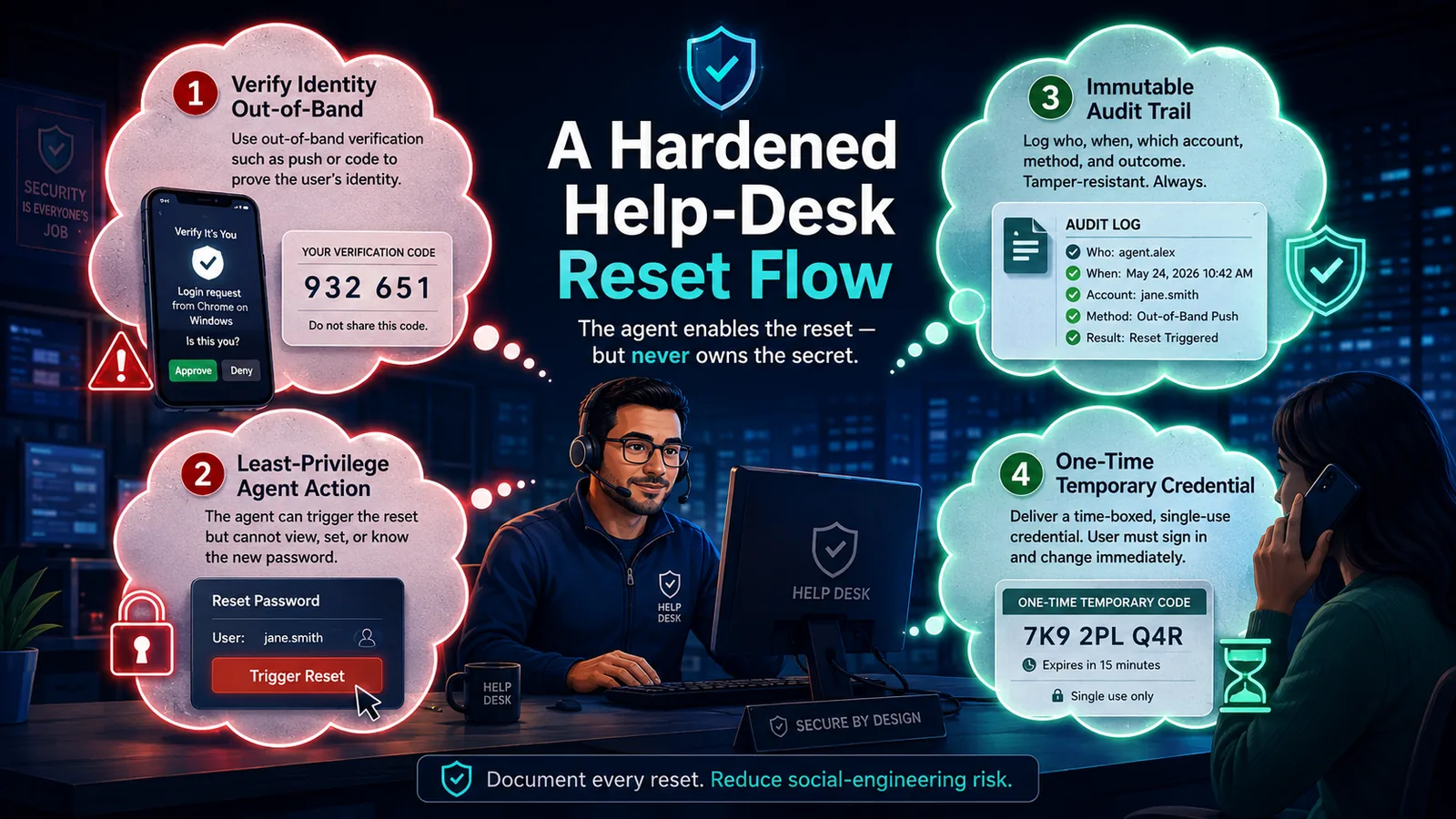 A hardened assisted flow constrains every step — the agent enables a reset out-of-band and never learns the secret the user ends up with.
Verify identity out-of-band. The agent should trigger verification through a channel the caller cannot simply assert over the phone — a push prompt to the user's enrolled device, or a one-time code delivered to a pre-registered channel. Caller ID is spoofable and security-question answers are researchable, so neither should stand alone. The verification should prove possession of something the real user controls.
Keep the agent action least-privilege. The agent's tooling should let them trigger a reset, not perform one end-to-end. A well-scoped workflow means the agent never reads the current secret, never sets the new one, and never sees a value they could later reuse. This shrinks both the insider-risk surface and the damage a compromised agent account can do.
Log every reset to an immutable audit trail. Each assisted reset should record who requested it, who performed it, which account was affected, and which verification method was used. That record is the evidence an auditor consumes for SOC 2, PCI DSS, and HIPAA control operation — and it is what lets an investigation reconstruct a suspicious reset after the fact.
Issue a one-time temporary credential with forced change. When a temporary secret is unavoidable, it should be time-boxed, single-use, and force a password change at next login. A permanent password read aloud over the phone is a standing liability; a one-time value that expires on use is not. The help-desk cost analysis covers why driving assisted-reset volume down — while hardening the resets that remain — is both a security and a budget win, since assisted resets are consistently among the most expensive service-desk tickets.
If you must keep security questions: harm reduction
Ideal and achievable are not always the same thing. Some organizations face legacy systems, contractual constraints, or user populations that make an immediate cutover impractical. If security questions must stay in the flow as a temporary bridge, apply harm reduction rather than pretending they are secure.
Never let a security question be the sole factor gating a reset — pair it strictly behind a strong factor so a guessed answer alone unlocks nothing. Limit answer attempts to a small number before the flow escalates to a verified help-desk path, closing the brute-force window. Avoid offering prompts whose answers are trivially public, and let users write free-form answers they can treat like a second password rather than a factual value an attacker can research. On privileged accounts, rotate or expire questions periodically. Every one of these measures is a bridge, not a destination — the objective remains full retirement, and each interim control should be time-bound with a plan to remove it.
The migration path: retiring security questions without breaking users
The reason security questions persist is rarely that anyone defends them — it is that removing them naively strands users who have no other recovery method. A staged migration avoids that.
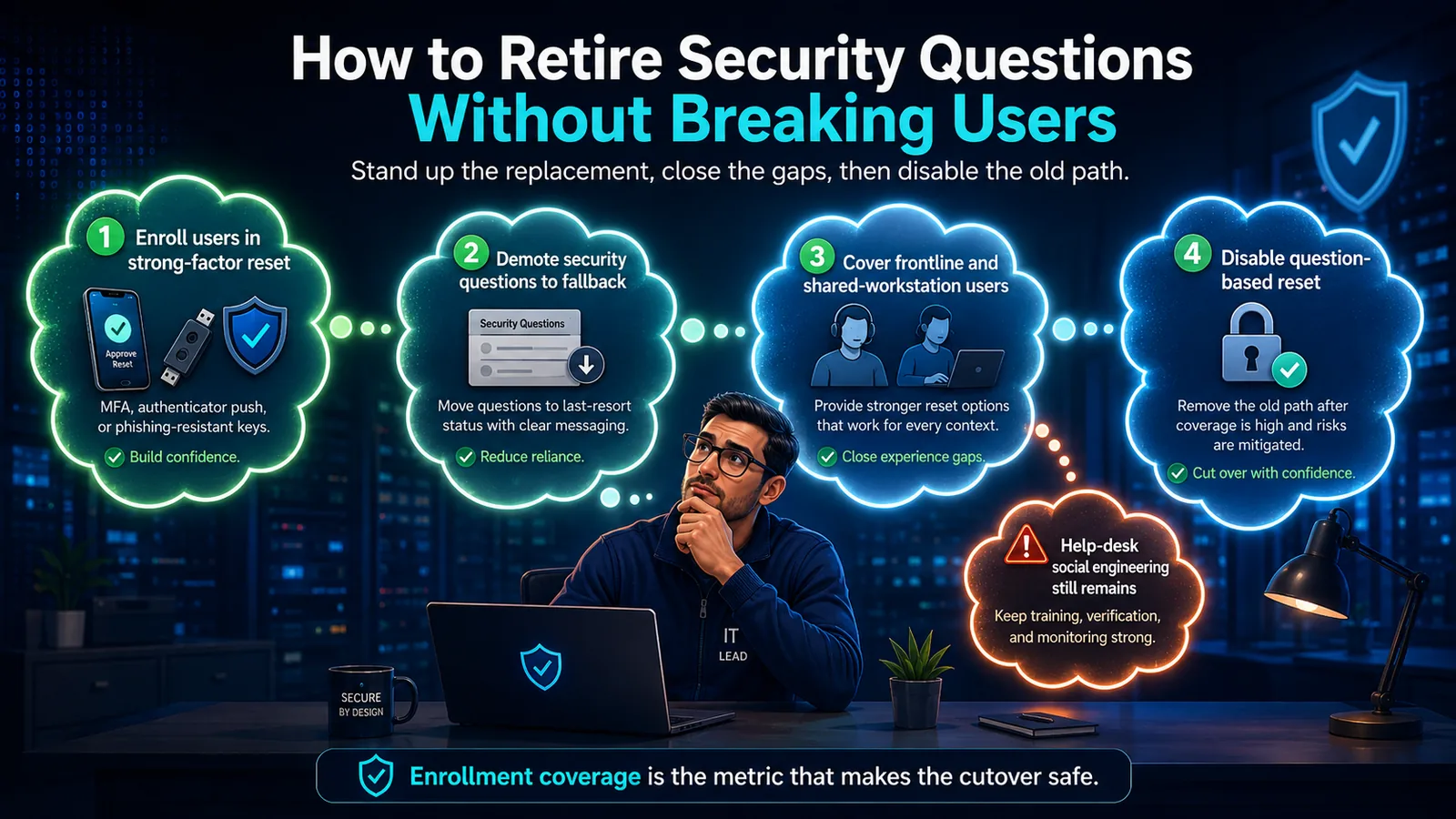 A staged cutover: stand up strong-factor self-service, demote questions to fallback, cover the frontline and shared-workstation edge cases, then disable question-based reset — with enrollment coverage as the metric that proves it is safe to pull the bridge.
Start by standing up the replacement: MFA-verified self-service reset, with enrollment driven through moments where identity is already established at high assurance — onboarding, managed-device provisioning, or an authenticated portal session. Enrollment is the real project; the reset flow is easy once coverage is broad. Next, demote security questions to a fallback used only by un-enrolled users while you close the enrollment gap, so every newly enrolled user stops depending on questions immediately.
Then cover the edge segments deliberately. The population most likely to be stranded is frontline, shared-workstation, and field staff without a personal smartphone — exactly the users a naive "just use an authenticator app" rollout forgets. A deviceless verification path such as the Identity Challenge Card keeps those users off security questions without assuming a device they may not carry. Finally, once enrollment is broad across every segment, disable question-based reset entirely and route the residual exceptions into the hardened help-desk flow above. The self-service password reset enterprise deployment reference covers the enrollment and coverage mechanics that make this cutover safe.
Instrument the migration so you can prove it is working rather than assume it. Two numbers matter most: enrollment coverage — the share of each user segment that has a strong factor registered — and the proportion of resets still completing through security questions versus strong-factor self-service. When enrollment coverage approaches full across every segment and question-based resets fall to near zero, the interim bridge has served its purpose and can be removed with confidence rather than crossed fingers. Watching those figures by segment also surfaces the populations quietly stuck on the old path — often the same frontline and shared-workstation users the edge-case coverage above is meant to catch — before they become the reason a cutover stalls or gets rolled back.
What Avatier ships toward this pattern
Avatier's approach to password reset is built around exactly this shift — away from knowledge-based verification and toward strong-factor self-service with a hardened assisted fallback. Self-service reset is gated by strong factors rather than security questions: authenticator push to an enrolled device, passkeys, and FIDO2-compatible hardware keys. For users without a smartphone, deviceless verification covers the frontline and shared-workstation segments so no population is left depending on guessable answers.
The help-desk workflow reflects the four controls above: out-of-band verification, least-privilege agent action where the agent triggers a reset without ever handling the secret, immutable audit logging of every reset event, and one-time temporary credentials with forced change. Because these resets sit inside the broader credential-governance platform, the audit trail integrates with the same evidence pipeline used for access reviews and lifecycle events — which is what makes the assisted path defensible under SOC 2 Type II, PCI DSS v4.0.1, and HIPAA review rather than a standalone gap. The password reset comprehensive guide covers how self-service, login-screen, and help-desk reset architectures compose into one program.
For teams that need to point auditors at posture rather than assertions, the Avatier Trust Center publishes the current compliance standing — SOC 2 Type II with zero exceptions, ISO/IEC 27001:2022 certified, PCI DSS v4.0.1 compliant, CSA STAR Level 1, NIST 800-53 Rev. 5 aligned, and CISA Secure-by-Design Pledge signatory.
The residual risk even a good reset flow carries
It would be dishonest to end on a note that suggests any reset program is airtight. The residual risk that survives even a well-built flow is help-desk social engineering — the human failure mode. An attacker who impersonates a legitimate user to a live agent, armed with the same OSINT that defeats security questions plus a plausible story and manufactured urgency, is attacking the person in the loop rather than the technical control.
The four help-desk controls reduce this materially. Out-of-band verification through an enrolled channel means a convincing story is not enough — the attacker also needs the real user's device or channel. Least-privilege tooling means even a deceived agent cannot hand over a secret they never possessed. Callback and cooling-off policies on high-risk accounts add friction where it matters most, and real-time audit visibility means a suspicious pattern of resets surfaces quickly. But none of these removes the risk entirely, because a human agent can always, in principle, be deceived.
That irreducible exposure is the strongest argument for the long-term direction: the fewer accounts that depend on passwords, the fewer reset events exist to socially engineer. Retiring security questions is the near-term win available to every team today. Expanding passwordless coverage so the reset problem shrinks structurally is the horizon that makes the residual risk smaller every year. Both point the same way — away from the knowledge-based model the original version of this post tried to optimize, and toward verification that proves identity instead of recalling a fact.
ABOUT THE AUTHOR

More from Pillar 4: Login Reset
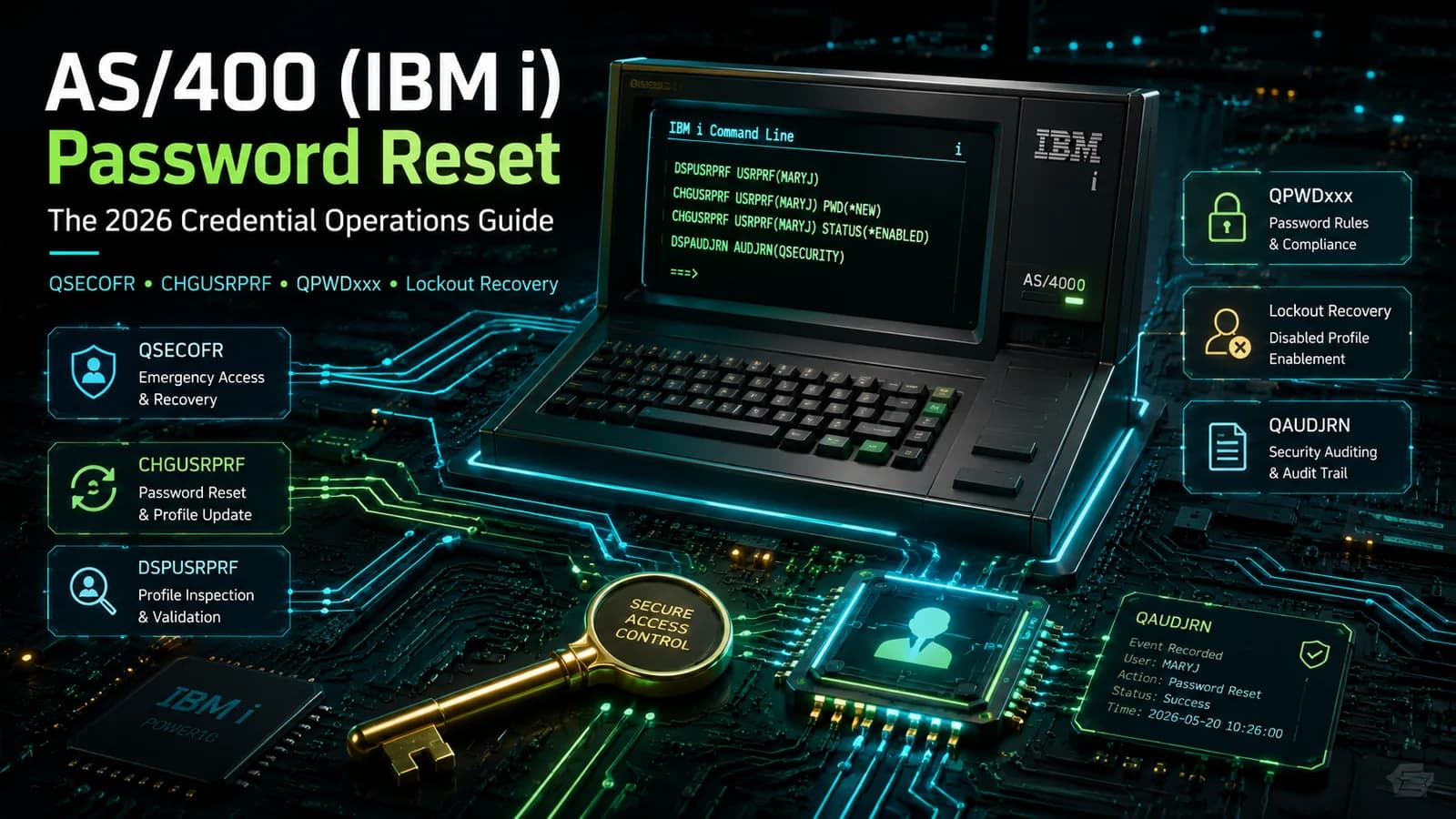
AS/400 (IBM i) Password Reset: The 2026 Credential Operations Guide
How password reset works on AS/400 (IBM i) — QSECOFR, user profiles, CHGUSRPRF, the QPWDxxx system values, disabled-profile recovery, and the hardening that keeps reset from becoming the weakest link.
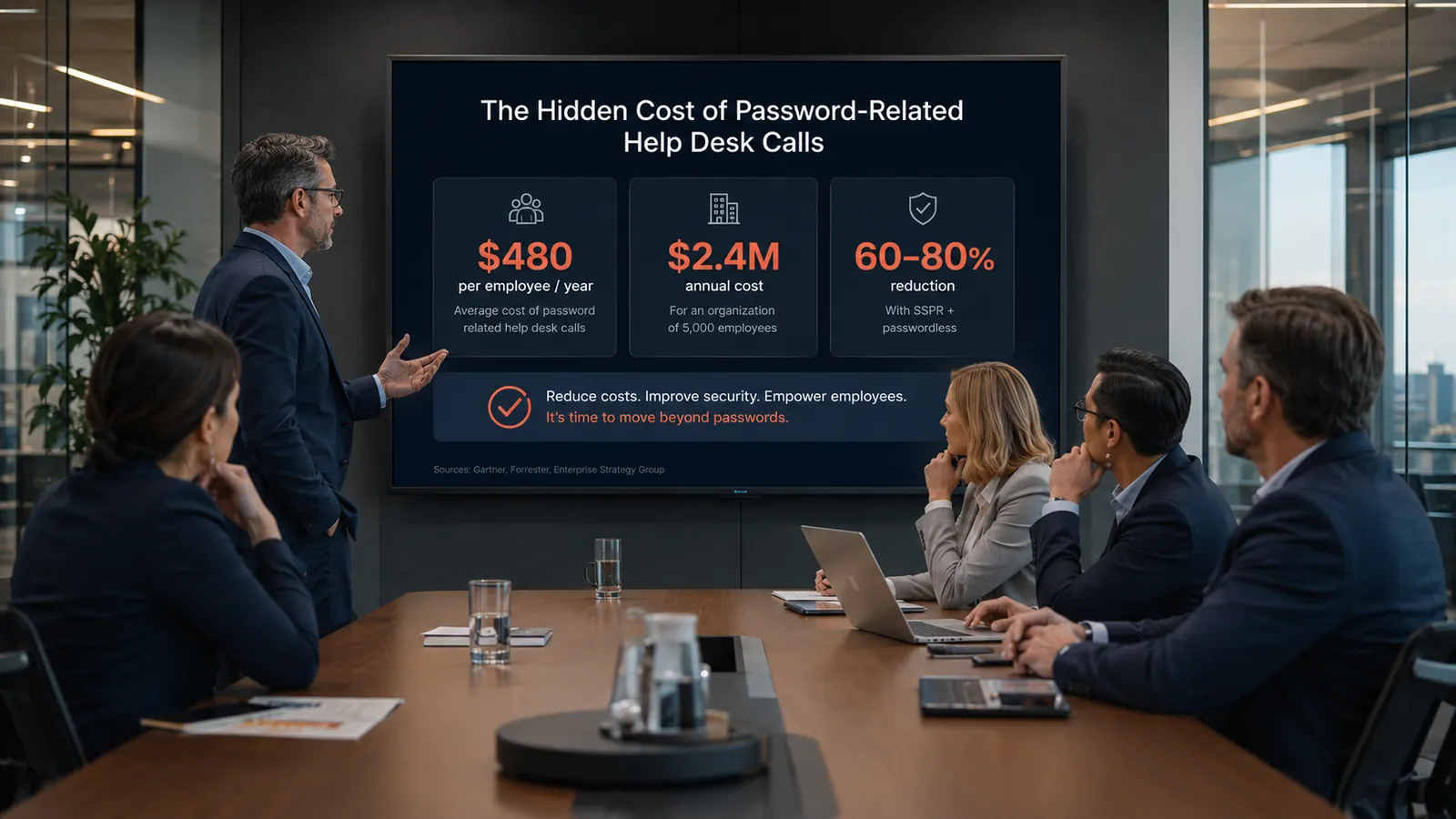
Password Help Desk Cost Analysis: The 2026 $480-Per-Employee Reference
Password-related help desk calls cost the average enterprise $480 per employee per year — a hidden line item that dominates IT operational cost at scale and produces $2.4M in annual burn for a 5,000-employee enterprise. The 2026 enterprise reference on the specific cost components, the volume drivers that scale the number by industry, the SSPR and passwordless architectural interventions that reduce it 60-80%, and the CFO-defensible ROI model that justifies the reduction investment.

Help-Desk KPIs & Reducing Password-Reset Tickets (2026)
Password resets are usually the single largest category of help-desk contacts — and the most reducible. This 2026 update covers the help-desk KPIs that actually matter for identity and password support, how to baseline them, and the specific levers — self-service reset, password synchronization, MFA-verified reset, and passwordless — that cut reset ticket volume and cost. Plus the hardened path for the tickets that remain, and an honest look at what the KPIs do not tell you.